ReMarx: Why Revolution, Not Just Reforms
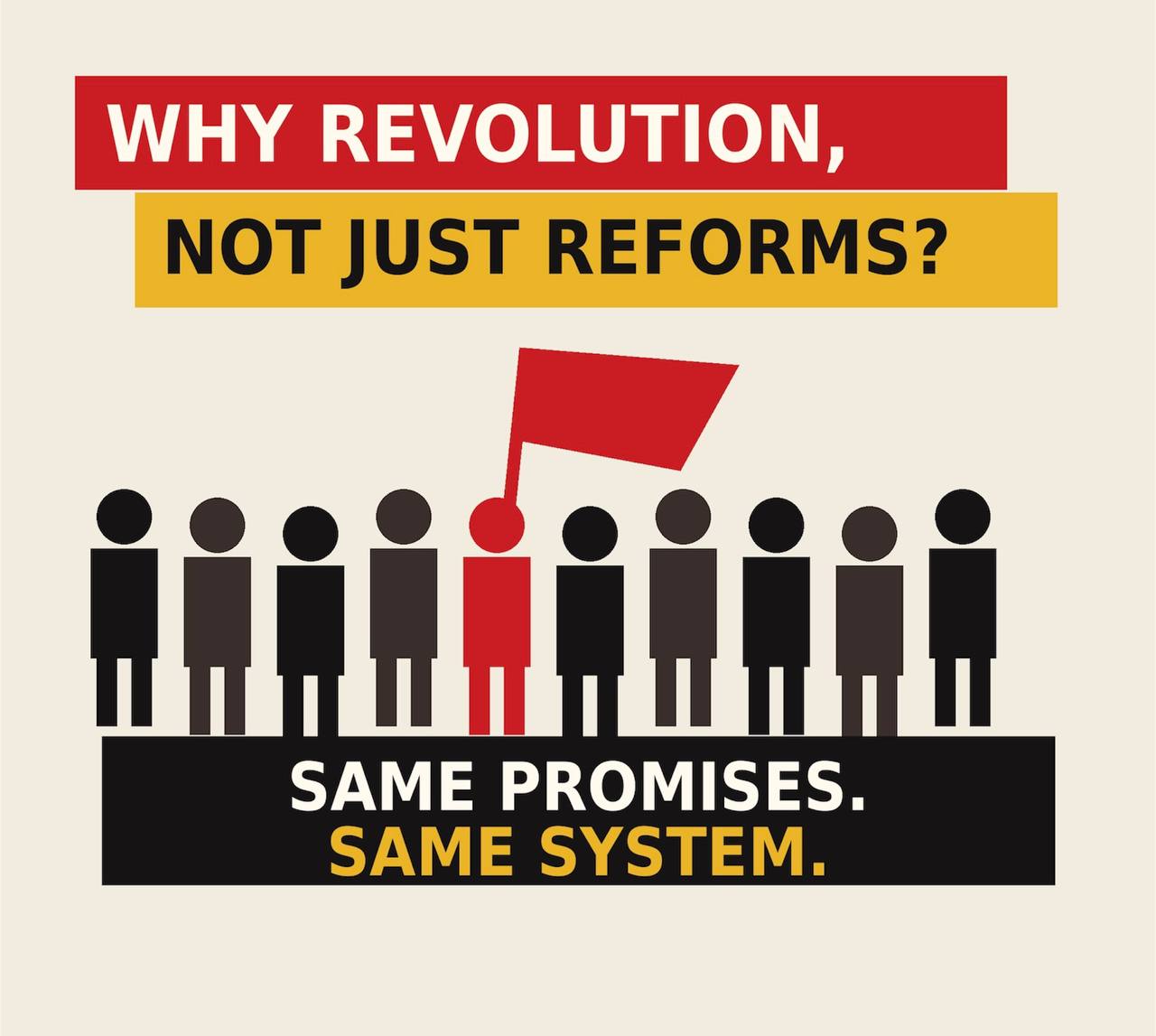
Why can’t Nigeria be fixed with better policies? Why do we insist that only a revolution can bring real change?
Every election season, politicians promise to fix Nigeria. A new minimum wage, another anti-corruption agency, a new constitution, better policing, and this time, they swear, things will be different. We have heard it all before.
These are reforms. A reform is a change made within the existing system, such as increasing wages, introducing subsidies, improving welfare or changing the law. A revolution goes further. It means changing who owns the wealth and who holds political power. Why do Marxists insist that reforms alone cannot fix Nigeria?
Are Reforms Useless?
Not at all. We fight for reforms, and we fight hard. A higher minimum wage can put food on the table. Better working conditions can improve people’s lives. Nobody should tell a nurse owed three months’ salary to wait patiently for the revolution before demanding payment.
More importantly, the struggle for reforms teaches working people something valuable: when we organise collectively, we can force those in power to make concessions.
A wage increase, a reduction in fuel prices or an improvement in public services is not handed down because politicians suddenly develop a conscience. Such gains are often won through struggle, strikes, protests and organised pressure.
But there is a problem. Even when we win these reforms, the victories are often limited, and sometimes what we gain today is taken away tomorrow. So why does this keep happening?
What Has Nigeria’s Experience Taught Us?
We need not look far. Nigeria’s own history provides the answers. In January 2012, Goodluck Jonathan’s government removed the petrol subsidy, causing fuel prices to jump overnight. Nigerians responded with massive demonstrations and a general strike organised by the Nigeria Labour Congress (NLC) and Trade Union Congress (TUC).
Occupy Nigeria brought workers, students and ordinary people into the streets across the country. The pressure forced the government to partially restore the subsidy, reducing petrol prices from approximately ₦141 to ₦97 per litre. It was a victory, but a limited one. The labour leadership called off the strike, the government remained in power, and the ownership and control of the oil industry remained largely unchanged. The wider programme of subsidy removal never disappeared. Then came May 2023. Bola Tinubu announced that the fuel subsidy was gone. Petrol prices rose sharply, followed by transport costs and the prices of everyday goods.
What the masses fought to preserve in 2012 was taken away in 2023!
We saw something similar during #EndSARS. In October 2020, young Nigerians took to the streets against police brutality, extortion and harassment. The government announced the dissolution of SARS and established judicial panels to investigate abuses.
But within days, another police unit, SWAT, was announced. Years later, serious questions remained about accountability, the implementation of panel recommendations and continuing police abuses. The name of the police unit changed, but the institution and the structures protecting abusive officers remained largely intact.
Does this mean Occupy Nigeria and #EndSARS achieved nothing? Certainly not. They demonstrated the power of collective action, forced concessions and showed that ordinary Nigerians could challenge the state. But they also revealed something important: winning a reform is not the same as changing the system that makes the reform necessary in the first place.
And that brings us to the real question.
Why Do We Keep Fighting the Same Battles?
Because the people who control the wealth also hold enormous power over the state.
Look around Nigeria. Millions of people work every day, yet struggle to afford food, housing, transport and other basic necessities. How can a country so rich in resources have so many people living in poverty? The answer lies in how wealth is produced, who owns it and who controls its distribution.
Working people produce society’s wealth, but a small class owns or controls the oil, banks, land and major companies. In Nigeria, much of that wealth is also accumulated through control of the state, through government contracts, licences, oil allocations and access to public resources.
In simple terms, we do the work, but the ruling class controls the wealth.
A reform may give workers a bigger share of what they produce, but it does not necessarily change who owns the wealth in the first place.
Take the minimum wage for example. As we explained in our earlier article, Who Are the Proletariat?, many Nigerian workers are employed informally, without contracts or regular salaries. When the minimum wage increases, the dispatch rider paid per delivery or the market porter paid per job may receive nothing. And for workers who do receive the increase, rising food, transport and fuel prices can swallow it almost immediately.
So we win something today, only to struggle for it again tomorrow.
But why is the government unable, or unwilling, to protect these gains? From primary school, we are taught that government exists to serve everyone equally. The police protect everybody, the courts dispense justice, and politicians represent the people. Yet look at how the state actually operates.
When workers strike, police are sent to break them up. When traders resist a new levy, task forces arrive to enforce payment. Yet contractors collect billions for abandoned projects and often face little consequence. This is not simply a problem of bad leaders. It reflects the class interests the state protects. The police, military, courts and government institutions operate within a system built around protecting existing property relations and economic power. Elections may replace one politician with another, but the underlying structure remains.
And because that structure remains, the ruling class can take back tomorrow what workers forced it to concede today.
This is the fundamental limitation of reforms. They can improve conditions, sometimes significantly, but they leave the ownership of wealth and the foundations of state power largely untouched.
So, Why Revolution?
Because the problem is not simply that Nigeria has bad policies or corrupt politicians. The problem lies in the organisation of society itself. A small minority controls the country’s wealth, while the majority who produce it have little say in how it is used. Changing the individuals in government does not fundamentally change this relationship.
A socialist revolution means the working majority taking control of the major resources and industries upon which society depends: the oil, banks, land and large companies. Rather than allowing a small class to determine how Nigeria’s wealth is used, that wealth would be collectively owned and democratically controlled to meet the needs of the majority.
Imagine an economy where decisions about housing, electricity, transport, healthcare and education are made according to what people need, rather than what generates the highest profits for a handful of individuals. But achieving this also requires political power. Workers cannot democratically control the economy while the institutions governing society remain under the control of those whose wealth depends on the existing system.
A revolution must therefore transform both the ownership of wealth and the class that controls the state.
Some people hear the word revolution and immediately think of violence. But we must ask: who uses violence to preserve the existing order? Throughout Nigerian history, workers, students and protesters have faced police repression and military force when challenging those in power. The ruling class has repeatedly demonstrated its willingness to defend its privileges through the coercive power of the state.
The greatest strength of working people, however, lies in their numbers, solidarity and ability to organise collectively. A revolution is not simply another protest, election or military coup. It is the organised working majority taking political and economic power into its own hands and fundamentally changing how society operates.
What Must We Do?
We must continue fighting for every wage increase, every improvement in working conditions, every expansion of public services and every democratic right. These struggles matter. They improve lives, develop political consciousness and teach workers the power of collective organisation.
But we must connect these immediate demands to the larger struggle over who owns the economy and who controls the state. Otherwise, each generation will continue fighting to recover what the previous generation already won. This requires independent working-class organisations, democratic trade unions and a revolutionary political movement capable of uniting workers, students and the poor around a programme for transforming society.
Our goal is not simply to negotiate better conditions under a system that continues producing poverty and exploitation. It is to end the class relations that produce them.
That is what we are organising for in Naija Marxists.
We fight for reforms, but we do not mistake them for liberation. We fight for a society in which working people themselves hold power and determine how the wealth they produce is used.
Reforms can make life better within the system. Revolution gives us the power to change the system itself.
If this makes sense to you, join us.