Six Years After #EndSARS
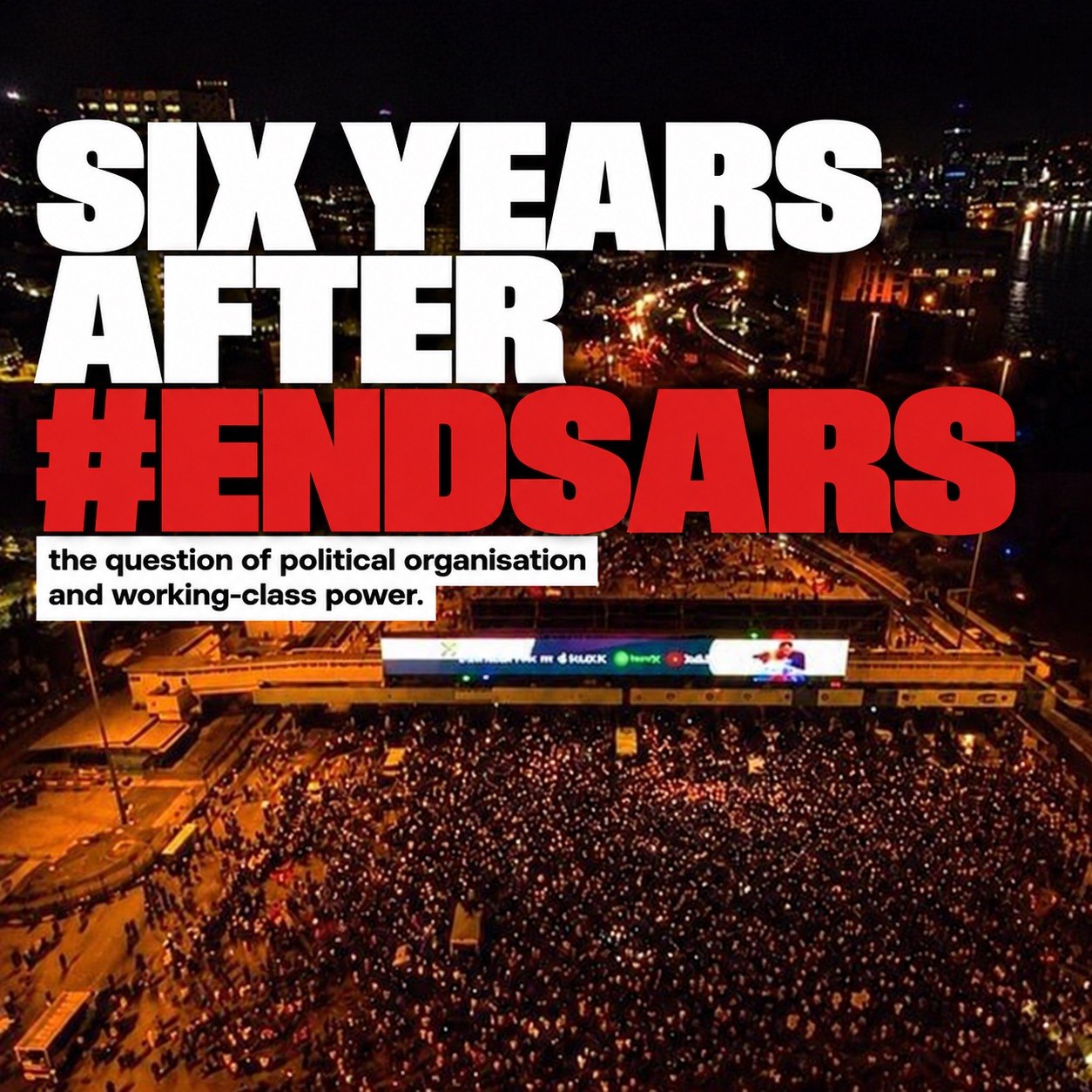
Six years ago, thousands of young Nigerians took to the streets to demand an end to police brutality. They were tired of being harassed, extorted, arrested and killed by the very institutions supposedly established to protect them. What began as a movement against the Special Anti-Robbery Squad (SARS) soon expressed a much wider anger at the conditions under which ordinary Nigerians were forced to live.
On 20 October 2020, soldiers opened fire on unarmed protesters at Lekki toll gate in Lagos. It is estimated that at least 56 people were killed nationwide during the protests. Six years later, we remember those who lost their lives, the survivors who continue to bear the consequences and the families still denied justice.
The State and the Limits of #EndSARS
The protests exposed the character of the Nigerian state. When young Nigerians challenged its authority, the government eventually answered with armed repression. The army and police do not stand outside the conflicts dividing our society. They are institutions through which the existing order is maintained, and at Lekki they demonstrated whose interests that order ultimately protects.
The movement also revealed the limits of spontaneous mobilisation. Its rejection of central leadership arose from a justified distrust of politicians and fears that leaders could be arrested or bought off. But the five demands remained confined to police reform, while the movement lacked the structures and programme needed to sustain a struggle against the state. When repression came, there was no organised leadership capable of coordinating a response or carrying the struggle forward.
The Youth Democratic Party
Even before the protests ended, some young Nigerians recognised the need for a political organisation of their own. In mid-October 2020, the Youth Democratic Party (YDP) emerged online, reportedly attracting close to 200,000 sign-ups within two weeks. Yet it never became a registered political party.
The YDP was assembled in a matter of days around a name, a logo and an online registration form. It had no developed political programme, accountable leadership or branches rooted in workplaces and communities. Its immediate ambition was to contest the 2023 elections, although it had not built the organisation necessary to sustain political activity beyond the excitement of the protests.
The willingness of so many young people to sign up was significant. It showed an appetite for political organisation that the existing parties had failed to satisfy. But registering interest in a party is not the same as building one. A revolutionary organisation requires members united around a programme, educated in its ideas and capable of acting collectively. Such an organisation cannot be improvised in the middle of an uprising.
Six Years of Searching
The years since #EndSARS have seen young Nigerians pursue different responses to the crisis confronting them. Many turned towards electoral politics. Between June 2021 and July 2022, approximately 12.2 million Nigerians registered to vote, with young people accounting for 71% of new registrants. Many who had participated in #EndSARS subsequently supported Peter Obi and the Labour Party.
But the 2023 presidential election returned the ruling All Progressives Congress to power. Bola Tinubu won with approximately 8.8 million votes in an election with a turnout of about 27%, the lowest recorded since the return to civilian rule in 1999. Whatever hopes were invested in the ballot, the fundamental ownership and control of Nigeria’s economy remained untouched.
Others sought a future outside the country. A 2022 Africa Polling Institute survey found that 69% of Nigerians aged 18 to 35 would relocate if given the opportunity. For many, leaving was a practical response to unemployment, insecurity and declining living standards. But emigration, however necessary for individuals, cannot resolve the conditions confronting the millions who remain.
By August 2024, Nigerians were back on the streets. The #EndBadGovernance demonstrations arose from anger over the cost of living and the government’s economic policies. At least 24 protesters were reportedly killed and more than 1,200 detained. Minors were among those subsequently charged with offences including treason.
The underlying question remains unanswered: how can working people build the power necessary to change the society producing these conditions?
The Question of Power
Six years after #EndSARS, the economic situation remains severe. The removal of the petrol subsidy in 2023 drove up transport and living costs, inflation reached 34.8% in December 2024, and the World Bank estimates that more than 60% of Nigerians lived below the national poverty line in 2025.
The hardship that drove young Nigerians onto the streets has therefore persisted, while the state continues to respond to mass protest with repression. Each struggle leaves behind experience, anger and political lessons. But these do not automatically develop into revolutionary consciousness or an organisation capable of challenging capitalist rule.
For the generation that marched in 2020, #EndSARS was its own great event, one it witnessed and took part in, and it radicalised them. Six years on, they still measure the state against Lekki, and #EndSARS remains their reference point whenever they speak of the police, of protest or of government. That experience has not dissolved. It accumulates with every price rise and every act of repression, in changes too small to register from above, until quantity turns into quality and the whole situation changes at once.
The next major confrontation may arise from the cost of living, unemployment, police brutality or another grievance altogether. Its immediate cause cannot be predicted. What can be established beforehand is the political organisation needed to unite these struggles and give them a revolutionary direction.
That organisation must be rooted in the working class. Workers occupy a decisive position because their labour sustains production, transport and essential services. Their collective action can interrupt the economic activity upon which capitalist profits depend. A movement rooted in organised workers, while drawing in students, unemployed people and other oppressed sections of society, has the potential to challenge the ruling class beyond the streets and at the foundations of its economic power.
To end what is grinding Nigerians down, power has to pass to the working class. Hunger, joblessness and police violence come from a state run in the interest of those who own the economy, and no change of government or police reform alters that. Only when workers hold political power and the principal means of production are owned in common can the country’s wealth be turned to the needs of the majority.
Organise for the Living
We continue to demand justice for everyone killed, injured, detained or abused during #EndSARS. Those responsible for unlawful killings must be investigated and prosecuted where the evidence warrants it. Victims and their families deserve compensation, rehabilitation and access to justice. These demands require sustained pressure from an organised movement.
The Naija Marxists are building that organisation. We are bringing workers, students and unemployed young people together through political education and collective struggle, developing a programme that connects the fight against police brutality and rising living costs to the ownership of the means of production and the question of political power.
Those who marched in 2020 and want the next movement to go further must help build that organisation now. We cannot wait until another uprising begins to develop the leadership, programme and political clarity it will require.
We owe the dead more than remembrance. We owe the living a struggle capable of changing the conditions that brought Nigerians onto the streets six years ago.
Remember the dead. Defend the living. Organise for working-class power.