Tinubu, Obi and the Business of Nigerian Electricity
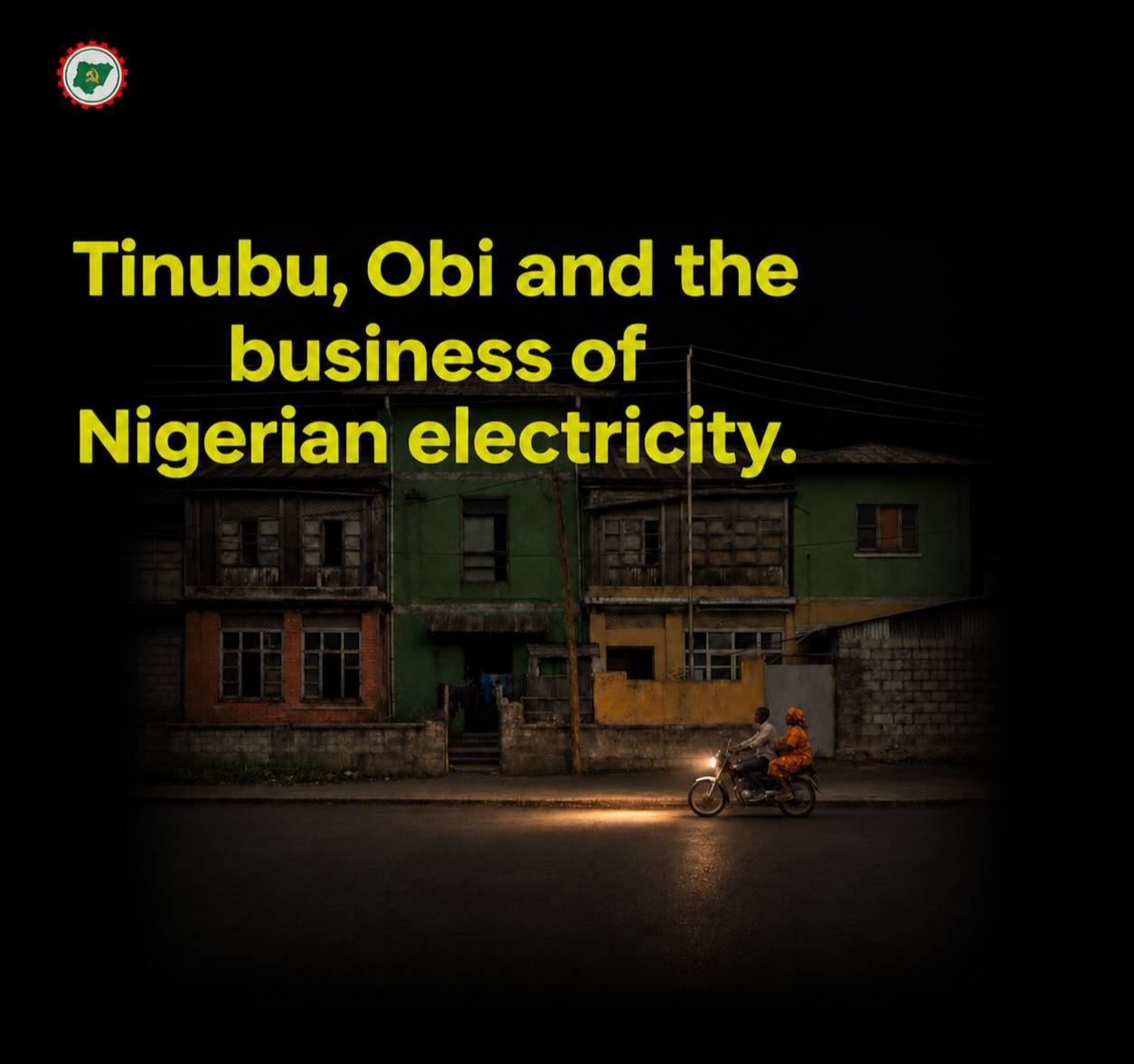
Under capitalism, electricity is produced as a commodity. It is generated, transmitted and sold wherever its owners can make a profit, while communities that cannot guarantee those profits are left to struggle in darkness. This is the contradiction at the heart of Nigeria’s electricity crisis, and the failure of privatisation since 2013 has exposed it repeatedly.
In December 2022, Bola Tinubu promised Nigerians electricity and told them not to vote for him for a second term if he failed to deliver, unless he could provide adequate reasons. His then Minister of Power, Adebayo Adelabu, went further, promising 20,000 megawatts by 2026. Well, we are now in November 2026. According to NERC, Nigeria’s 28 grid-connected power plants had an average available capacity of just 4,286 megawatts in April, out of an installed capacity of 13,625 megawatts. That is barely 31%! Even the celebrated generation record of 5,801.84 megawatts, achieved in March 2025, exceeded the previous record from 2021 by a ridiculous 0.24 megawatts! Faced with this embarrassing record, Tinubu’s spokesperson, Bayo Onanuga, has been busy explaining why the President never promised uninterrupted electricity. Apparently, Nigerians are now expected to accept explanations in place of electricity!
Where the Blame Goes
For years, distribution companies blamed transmission for the lack of electricity. Yet the Transmission Company of Nigeria now claims it can transmit 8,700 megawatts and has consistently carried the electricity made available to it. So we have power stations designed to generate 13,625 megawatts, a transmission network claiming a capacity of 8,700 megawatts, and a population sharing roughly 4,000 megawatts against estimated demand exceeding 30,000 megawatts. A major problem is the shortage of gas supplied to power plants, itself aggravated by debts throughout the privatised electricity system. Onanuga admitted that gas companies were owed over ₦4 trillion. By March this year, generation companies were claiming approximately ₦6.8 trillion in outstanding payments. The companies cannot pay their suppliers, the plants cannot generate enough electricity, and Nigerians are left in darkness.
Bailouts and Tariffs
And what is Tinubu’s solution? Pay the owners more! In April 2026, his government approved a ₦3.3 trillion settlement of verified legacy debts under its wider ₦4 trillion power-sector debt programme. Tony Elumelu’s Transcorp group is among the beneficiaries of the settlement arrangements. Public resources are being committed to rescuing an electricity industry that was privatised precisely because Nigerians were told private ownership would make it more efficient. We collectively carry the burden, while private owners retain control. What exactly was the point of privatisation if the Nigerian people must continue financing its failures?
The electricity tariffs expose the other side of this arrangement. In April 2024, NERC increased Band A tariffs from around ₦68 to ₦225 per kilowatt-hour, with subsequent adjustments. There is an extreme class character in this arrangement. Electricity is increasingly directed towards feeders where companies can recover higher tariffs, while poorer communities continue struggling with unreliable supply. And even those paying premium rates are not guaranteed the electricity they are promised! In June, NERC ordered compensation for Band A customers whose feeders had received less than 18 hours of daily supply during February and March.
When we compare these figures with Nigeria’s ₦70,000 monthly minimum wage, at ₦209.50 per kilowatt-hour a household consuming 200 units would pay ₦41,900 before VAT, almost 60% of that miserly minimum wage! Tinubu’s Chief of Staff, Femi Gbajabiamila, admitted that the minimum wage needed reassessment, yet the government rejected the NLC’s demand to commence negotiations, insisting that the wage was not due for review until June 2027. Meanwhile, the Presidency defended a ₦10 billion solar project for Aso Rock. The government has public money to secure electricity for those in power, but ordinary workers are told to endure darkness.
Obi’s Alternative
Peter Obi has made electricity a central issue in his criticism of Tinubu, but what exactly is his alternative? Obi has said that his government would liberalise the entire electricity sector, including transmission, while offering private investors attractive financing, tax incentives and sovereign guarantees. Generation and distribution are already privatised, and his solution is to extend private participation to the remaining publicly controlled part of the system! As the NDC’s presidential candidate for 2027, Obi promises to generate, transmit and distribute at least 10,000 megawatts, particularly through embedded power projects modelled on Geometric Power in Aba.
But who will own this expanded electricity capacity, and who will be able to afford it? Private investors direct their money towards activities that promise adequate returns. Universal electrification, which is what Nigerians desperately need, requires investment in poor communities and neglected regions where immediate profits will be limited. Obi’s proposed industrial electricity projects in places such as Bompai and Sharada in Kano may provide power to businesses, but what happens to the working-class household in Ajegunle or the fishing community in Bayelsa? His proposal for sovereign guarantees makes the contradiction even more obvious. When the government guarantees private investments, public resources are placed behind the commercial risks of private investors. The same logic underlies the government’s repeated interventions to rescue the electricity industry. So, while Tinubu and Obi quarrel over who can manage Nigeria better, they remain committed to the same fundamental economic arrangement. Both treat electricity as a commodity and would both leave its supply at the mercy of profit!
The alternative requires a fundamental reorganisation of the electricity sector around public need rather than private profitability. Nigeria possesses enormous gas reserves, generating infrastructure and the labour and technical expertise needed to electrify the country. What prevents these resources from serving society is an economic system that places private profitability above public need! What Nigerians need therefore is the demand for the expropriation of the privatised generation and distribution companies, an independent workers’ audit of their accounts and the repudiation of illegitimate debts used to justify endless public bailouts. Domestic gas supply must be prioritised for electricity generation, while tariffs must be placed under democratic oversight and made affordable to working people! But nationalisation under the same political class would simply reproduce the old problems under another name. The entire electricity industry must be brought under the democratic control and management of electricity workers, engineers and the communities it serves.
These demands will not be delivered by Tinubu, Obi or another politician promising to manage capitalism more efficiently. They must be fought for by workers, trade unions, students and communities organising independently against blackouts, unaffordable tariffs and private ownership. Electricity is the product of social labour and must serve social needs. Until we take ownership and control away from those who profit from our deprivation, darkness will remain the experience of the many and electricity profits the privilege of the few.