The Unfolding of the Peter Obi Myth
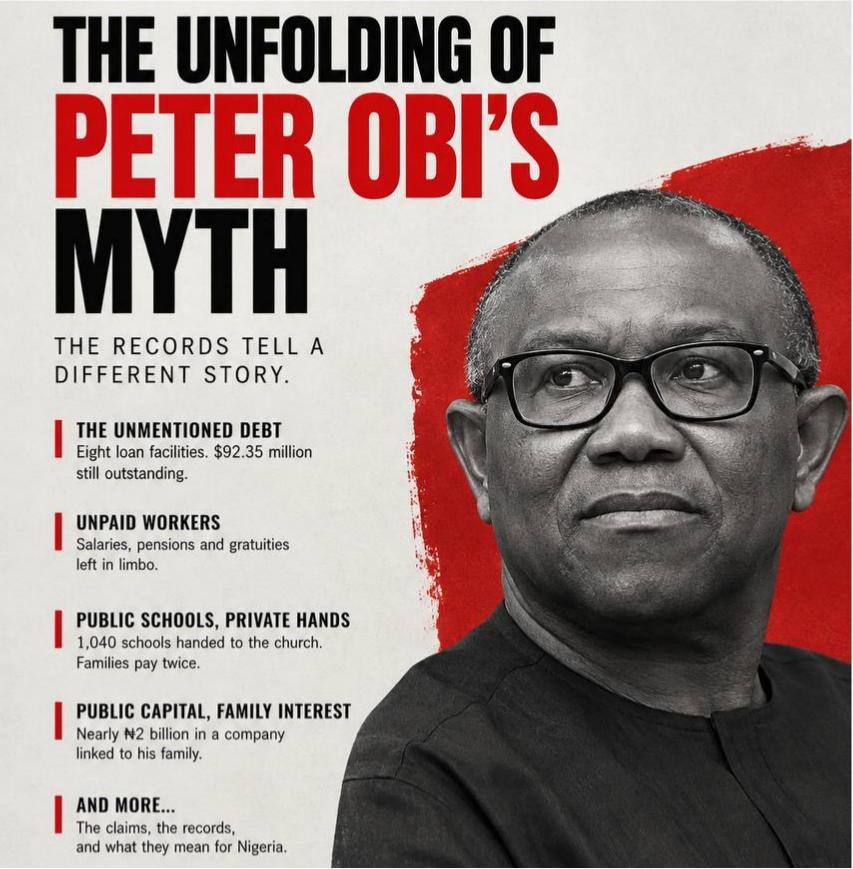
Peter Obi has spent years building a national political brand on one claim. According to him, the rest of Nigeria’s political class borrowed, squandered and stole, while he ran Anambra State with rare honesty, frugality and competence. He and his supporters have repeated this at every rally, interview and debate since the 2023 presidential race. The records now published tell a different story. Obi’s reputation, as that of the rest of the Nigerian ruling class, was carefully manufactured.
The Unmentioned Debt
Obi has said repeatedly that he never borrowed and left Anambra free of debt. The Anambra government’s own records list eight external loan facilities signed under his administration, worth $123,771,179.30. As of 30 June 2026, $92.35 million of that is still outstanding, and the people of Anambra are still paying it.
His defenders have offered several excuses. They say the facilities were concessional, that the World Bank supplied them, that the federal government negotiated them, and that some money was drawn after he left office. A loan at low interest is still a loan, and the state still has to repay a debt negotiated even through Abuja. Obi signed Anambra into obligations that outlived his tenure by more than a decade and then told Nigerians he left no debt, which was an outright lie.
The Anambra workers paid for his balance sheet. More than 700 workers of the defunct Anambra State Water Corporation were left without their salaries, pensions and gratuities. A 2009 arbitration and a 2019 National Industrial Court judgment both held the state liable. The present government had to negotiate a ₦1.563 billion settlement and had paid about ₦1.2 billion of it by September this year. Obi’s government also verified 16 months of arrears owed to primary school teachers, paid five months and left the other eleven for his successors.
State doctors also went on strike for 13 months because Obi refused to implement the salary structure his government had agreed with them. The Anambra branch of the Nigerian Medical Association accused his administration of neglecting state hospitals, underpaying doctors and favouring mission hospitals. This is what his celebrated prudence consisted of: unpaid workers, underfunded hospitals, and a cash balance held up as proof of virtue.
Obi insists he is not corrupt, and he can say so safely because Nigerian courts almost never convict governors. The EFCC charged 13 former governors with fraud in 2007 alone, yet since 1999 only three governors have gone to prison, and a sitting president later pardoned each of them. A clean record means very little in that system, and Obi is asking the ordinary Nigerian to accept his as proof of honesty!
Public Money under Church Control
In 2011 Obi handed 1,040 primary schools to the Catholic and Anglican missions and announced ₦6 billion for their maintenance and rehabilitation.
It should be noted that the missions built Anambra’s first schools, but the state took every one of them over in 1970 with the declared aim of ending the religious and sectional divisions the denominational system had entrenched and bringing education under a single public authority. Successive governments, however, starved those public schools of money for four decades. Obi blamed the decay on the takeover itself, and his remedy was to hand the schools back. The churches took ownership and day-to-day control, while the state went on paying the teaching and non-teaching staff and funding infrastructure.
Research on schools returned to mission control shows that fees, levies and other poorly regulated charges remain a persistent burden on families.
After giving away control, Obi signed Anambra into the World Bank’s State Education Programme Investment Project, with Anambra’s share at $48.33 million, and $37.34 million of it was still outstanding in 2026. That money went on teacher deployment, school management and learning assessment in a school system the state had largely surrendered away from it’s control!
This means that the families in Anambra paid for their schools twice: once through taxes and debt repayments, and again through the charges levied inside mission schools! The public carried the cost while the school was run by private individuals!
We fight for free, secular education, properly funded and run democratically by teachers, workers, parents, pupils and communities.
Public Capital and Family Interest
Additionally, and this news has been exposed for a while, Anambra put ₦1.955 billion into a 10% stake in Intafact Beverages, worth about $12.24 million at the official rate of the time. Obi later inflated the figure to more than $20 million and boasted about how much the stake had grown. By June 2022 it was worth about $5.38 million at the official exchange rate.
When the brewery opened, Corporate Affairs Commission records listed three shareholders: SABMiller, the Anambra State Government and Next International, a company tied to Obi and his family. The governor of Anambra placed nearly ₦2 billion of public money in a company in which his own family business also held shares. That is a conflict of interest, and no amount of talk about frugality can wash it away.
The Pandora Papers exposed offshore companies linked to Obi and his family. Obi then admitted that he did not declare some of these companies, or the assets they held, to the Code of Conduct Bureau, as the law requires of every public officer. Records also show that he stayed on as a director of Next International UK after becoming governor, despite the Code of Conduct barring serving public officers from running private businesses. The preacher of transparent accounts kept his own family’s offshore holdings off the record.
Obi’s answer to every question about money is his own fortune: he is a rich man and he has no reason to steal from Nigeria. The brewery deal and the undeclared offshore companies provide more context to this mirage painted. Obi is a capitalist, and he governed as one. His fortune comes from trade, banking and shares, which is to say from the labour of other people, and in office he set public money to work beside his family’s capital.
This is a symptom of Nigeria’s ruling class. They use state power to shore up and feed their private wealth and vice versa, whilst the workers and ordinary Nigerians are left with nothing but starvation, a worsening economy and a degraded standard of living.
Tinubu Is No Different
If you raise any of these, Obi’s supporters will answer at once by asking why anyone would attack Obi when Tinubu is worse. We oppose Tinubu’s government without mercy. His fuel-price deregulation and naira devaluation have driven millions deeper into poverty, and his government attacks working people at every turn. But Tinubu’s crimes do not turn Obi’s lies into truth, and pointing at the greater crimes of one faction of the ruling class does not clean the other!
Tinubu and Obi only differ in approach but are the same in policies! Both campaigned in 2023 on ending the fuel subsidy, and Tinubu removed it on his first day in office. Each has governed on World Bank credit and left the repayments to working people. Public goods pass into private hands under both. Tinubu calls the resulting hardship reform and Obi calls it prudence, and under either name the working class pays for the crisis of capitalism.
Both govern through brazen patronage, accumulation through the state and naked neoliberal assault. Obi offers lean government, privatisation, church and private management of public services, and a balance sheet placed above public need. Tinubu tells workers their hardship is the price of reform, and Obi tells them their deprivation is proof of good management. Both make the working class pay for the crisis of capitalism!
We refuse the choice between Tinubu, Obi, Atiku, Soludo or any other recycled Nigerian ruling class! No faction of Nigeria’s capitalist ruling class can lead the country out of its crisis. They cannot deliver universal education, healthcare, jobs, housing or working infrastructure, because every one of them defends the private accumulation, debt dependence and market rule that keep destroying those things.
The ordinary Nigerian therefore has no use for a capitalist with a clean image who manages scarcity more tidily. Working people need organisation independent of every ruling-class party: militant trade unions, organised communities and schools, and a mass socialist party. The banks, the energy system, the major industries and the commanding heights of the economy must be taken into democratic public ownership and planned for human need, not profit!
Millions have been taught to expect deliverance from the personal virtue of a billionaire administrator. No individual, however spotless his image, can reconcile profit with need or private accumulation with working-class freedom. Obi’s halo is false, and the system that manufactures such halos must be overthrown!