The Death and Autopsy of May 29: Three Years of Tinubu. Democracy Day, a Funeral
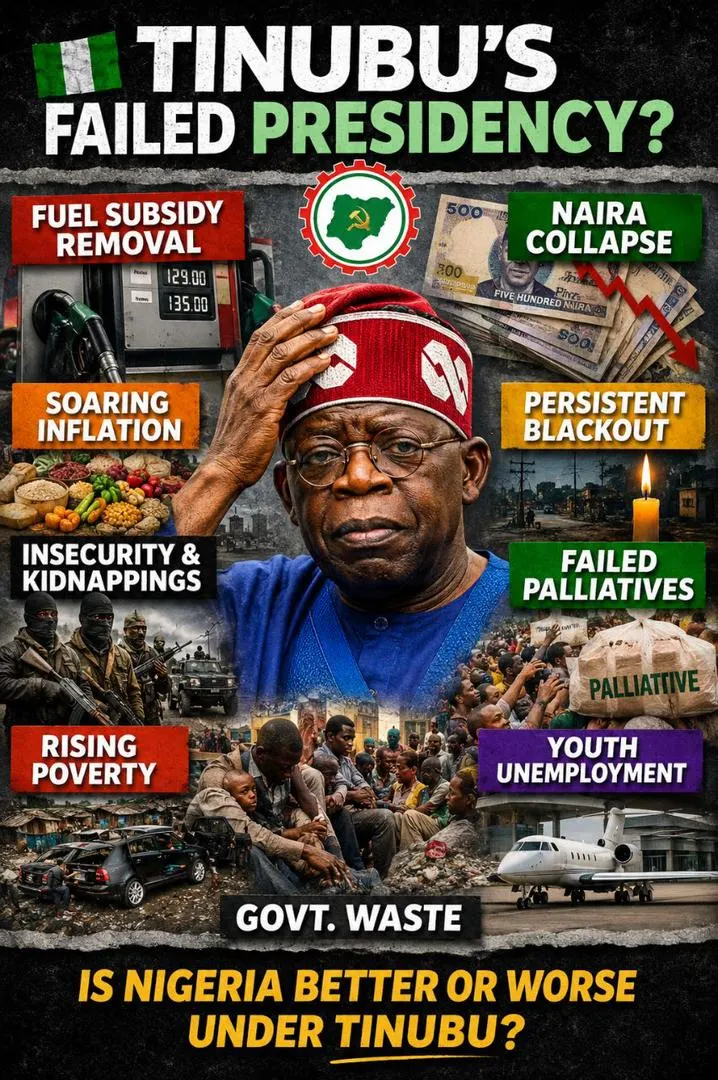
On 29 May the Nigerian state will mount its annual parade. The President will read a speech about reforms beginning to bite, brighter days ahead, and ask the country to endure a little more, from inside a convoy that has never queued for fuel and a class that flies abroad for its medicine and schools its children there. On paper, 1999 lifted Nigeria from the barracks to the ballot; in the streets, twenty-six years on, more than 140 million Nigerians, around 63% of the country, queue for a meal that does not come and send children home for fees they cannot pay.
Three weeks before the parade, on Workers’ Day, the President himself declared poverty a national emergency, as if the hunger had blown in from outside his own three years in office.
Guns Blazing into a Recession
The hunger Nigerians live with has a maker, and his name was on the platform on 29 May 2023.
The masses of this country have never been spared, of course; a capitalist order breeds hunger as surely as it breeds profit, and we have been bled by it since the British handed independence to a class of middlemen in 1960. But the catastrophic failure of one man at the top can pour petrol on a fire already burning, and that is what Bola Ahmed Tinubu has done.
On the morning of his inauguration, Tinubu scrapped the fuel subsidy in one sentence. Within weeks his Central Bank floated the naira and let it shed about 70% of its value. Not a kobo of cushion was set down for the workers who would be crushed under it. The IMF and the World Bank, who had pressed these same measures on every Nigerian government since the 1980s and been refused each time, applauded at last. The naira closed 2023 at ₦899 to the dollar; by end-2024 it stood at ₦1,535, and at its worst above ₦1,600. Every saving a Nigerian held in naira was halved at one stroke, while the propertied class, who keep theirs in dollars and in foreign accounts, were not touched by a kobo.
Take it to the worker’s pay packet. The minimum wage was raised from ₦30,000 to ₦70,000 in July 2024 and announced as a great act of generosity. But ₦30,000 in 2019, when it was set, was worth $98 at the then-official rate of ₦307. The same ₦30,000 the day Tinubu took office had already shrunk to $65. The new ₦70,000, even at today’s improved rate of ₦1,375, comes to $51. Put it in the worker’s hand: in 2019, ₦30,000 paid for a 50kg bag of rice at ₦15,000, his transport for a fortnight, kerosene, and his children’s school fees. In 2026, ₦70,000 will not buy one bag of rice. Transport that cost ₦100 a trip in 2019 demands ₦500 today. Petrol that filled a tank at ₦197 a litre in 2023 drinks four times that. A raise has been written in naira; a pay cut has been driven into the worker’s stomach.
The same conjuring was run on the public accounts. Tinubu boasts of a ₦55 trillion budget for 2025. Convert it: thirty-five billion dollars. A country of 220 million people, sitting on an ocean of crude oil and gas, plans its year on less than what Kenya, a country one-quarter its size, manages. Africa’s giant has been starved for three years and dressed in a larger suit, and the costume called recovery.
The Reforms Doing the Opposite
Three years of what Tinubu and his ministers called “Renewed Hope” have produced the opposite of every promise this government made. Tinubu told us the reforms would attract foreign capital to build factories and hire Nigerians. Capital came, alright, and went straight to the bond market to feed at the 27% the state pays its lenders. Foreign direct investment, the real money that builds a factory or hires a worker, came to a starving $923 million for the whole of 2025, under 4% of total inflows. The other 85%, around $20 billion, was hot money come to collect at 27% and bolt the moment the rate dips. Tinubu calls this “investor confidence.” In plain Nigerian, it is the confidence of looters that the state will keep handing them twenty-seven kobo on every naira lent to it, while the welder, the seamstress, and the small farmer lock their gates. Nigerian factories shut at the rate of two every day across 2025, and investment in real manufacturing fell by half.
Tinubu’s revenue numbers are no better. He crashed the naira, revalued the same oil exports at the broken rate, and the budget swelled in naira without a single extra barrel lifted from the ground. He toured the country praising “revenue growth”; the seed corn ate itself. The foreign-exchange gains that flattered the 2024 books collapsed by 73% in the first half of 2025, with individual months down 81%, 85%, even 90% year-on-year, and first-quarter revenue came in 31% below target. The boom is finished; the same depreciation cannot be performed on the same currency twice.
Inflation rose from 23% the day Tinubu took office to 35% by the end of 2024, the highest this country has known in three decades. At Mile 12 market in Lagos, the bowl of food that cost a woman ₦703 to put together for her family in 2023 cost ₦1,371 by October 2024, the same plate at twice the price, while her husband’s pay-slip did not move until July of that year. The CPI was then rebased so the rate would read smaller on television, but even the cooked figure has begun climbing again, reaching 15.7% in April 2026. The last argument Tinubu had, that inflation was easing, is dying on the page in front of him.
At the market, the new ₦70,000 minimum wage will not buy a single 50kg bag of rice, which sits between ₦60,000 and ₦82,000 across most of the country, while the ₦30,000 wage of 2019 bought a worker two such bags. The raise shrank the wage, and Tinubu told us to be grateful for it.
Cooking the Books
Faced with the wreck of their own making, Tinubu and his statisticians did what every failing regime does once it gets its hands on the National Bureau of Statistics. They cooked the books, in three brazen sittings.
The first was GDP. In 2025 the Bureau rebased the national accounts and lifted the nominal economy 34% overnight. Even with that thumb on the scale, Nigeria’s dollar economy came to $243 billion, less than half the $510 billion the country managed in 2014, and fourth on the continent behind South Africa, Egypt, and Algeria. The growth they paraded was a larger price tag on the same wreck.
The second was inflation. The CPI was rebased in January 2025, the basket of goods quietly widened, and the reported rate dropped from 34.8% to 24.5% in a single month, without one price falling in any market a Nigerian shops in. They changed the ruler so the wound would measure shorter.
The third, and most shameless, was unemployment. In 2023 the NBS adopted a methodology that counts anyone who worked for one hour in the past seven days, even for ₦500, as “employed.” Overnight, official unemployment fell from 33.3% under the old framework to 4.1% under the new, while KPMG, on the older method, estimated 2023 unemployment at 40.6%. A country of mass joblessness, of graduates riding okada because there is no other work, was rebranded by decree as a country at near-full employment. The graduate driving the okada was relabelled employed. The young man hawking puff-puff between cars in Lagos traffic was relabelled employed.
Bound Hand and Foot
Tinubu’s ministers say they have no choice. The rate must stay near 27%, the borrowing must continue, the IMF’s conditions must be met. On their narrow terms they are right. The rate cannot be brought down toward the 2% the wealthy economies treat as their floor, because the hot foreign capital came for the yield and nothing else. Cut the rate and it bolts; the naira drops; inflation breaks loose. So Tinubu strangles his own farmers and welders to keep his creditors calm. The men who run this country are paid to hold those chains. They will not break them. The arrangement is the prison.
The Class That Can End It
Goodluck Jonathan ran this same machine before Buhari and before Tinubu. The story now in fashion that he was pushed out in 2015 by the hidden hand of empire runs exactly backwards: empire kept Jonathan, because Jonathan served it, broke up the national power company and sold the pieces to private profiteers, and announced from the same podium Tinubu now stands on that government would be a “mere facilitator” while he threw the economy open to whatever capital wanted in. Peter Obi, who condemns the chaos and offers himself in 2027, would run the same machine more competently in the very same direction; his programme is private capital, fiscal discipline, the state cut down to a doorman for the investor. The face on the ballot has changed under five presidents. The class behind it has not.
Nothing will come from that class. And nothing will come from charity. The NGOs, the foundations, the foreign-funded “governance reform” projects, the international observers and the latest aid envelope can write a thousand reports and not move this country one inch out of the pit. We will not charity our way out of this. We will not NGO our way out of this. We will not vote our way out on a ballot offered by the same class that built the pit.
The one force in this country with both the reason and the power to end what 29 May commemorates is the working people on whose backs every wheel of this country turns. The man at the lathe, the woman teaching the children, the driver, the trader, the nurse, the farmer who plants the food no man in the convoy thanks him for, these are the people who make Nigeria work. Nothing leaves the port without them. Not one bulb lights without the linesman.
The day they decide to stop, this whole groaning machine stops with them. Yet the working class does not strike its blow by spontaneous combustion. Revolutions happen at the meeting place of two forces: the objective conditions — the immiseration of the masses, the collapsed wage, the closed factory, the rotten state, the dead promise of every election, already here, ripe, screaming for resolution — and the subjective force, the conscious vanguard party of the working class, disciplined, rooted in the workplaces and the campuses, ready to lead when crisis breaks.
The first is the work this regime has done. The second is what is still missing, and building it, so the working class has the instrument equal to its hour, is the work the Naija Marxist Movement has set its hand to.
That work runs against a current. The leadership of the Nigeria Labour Congress, of the Trade Union Congress, of the Labour Party itself, has lost any revolutionary morality. They call a general strike on Monday and call it off Wednesday for a handshake at the President’s table, a contract for a relative, a seat on a committee. The Labour Party, the party that wears the very name of labour, fielded a businessman for president on a programme of privatisation. These men are agents of the bourgeoisie inside the workers’ movement, in Lenin’s exact phrase.
Yet beneath that betrayal a new generation of Nigerian youth is rising that the rulers cannot smother, taught by the blood at Lekki in 2020 and the bullets fired across the North in EndBadGovernance and FearlessOctober in 2024 that this order has nothing to offer them. They answer with tear gas and live rounds because they have nothing else.
Let them hold their parade. Let Tinubu read his paper victories to a country he has helped to starve, from a table that has never wanted for anything. The autopsy of this Democracy Day returns one verdict: the promise of 1999 is dead, and the class that has held the body since 1960 cannot revive it. The day is coming when those who alone have made this country work take it into their own hands. That day will not arrive on its own.
We are building it. Let us begin.
@TheNaijaMarxists