The Class War for Our Lives
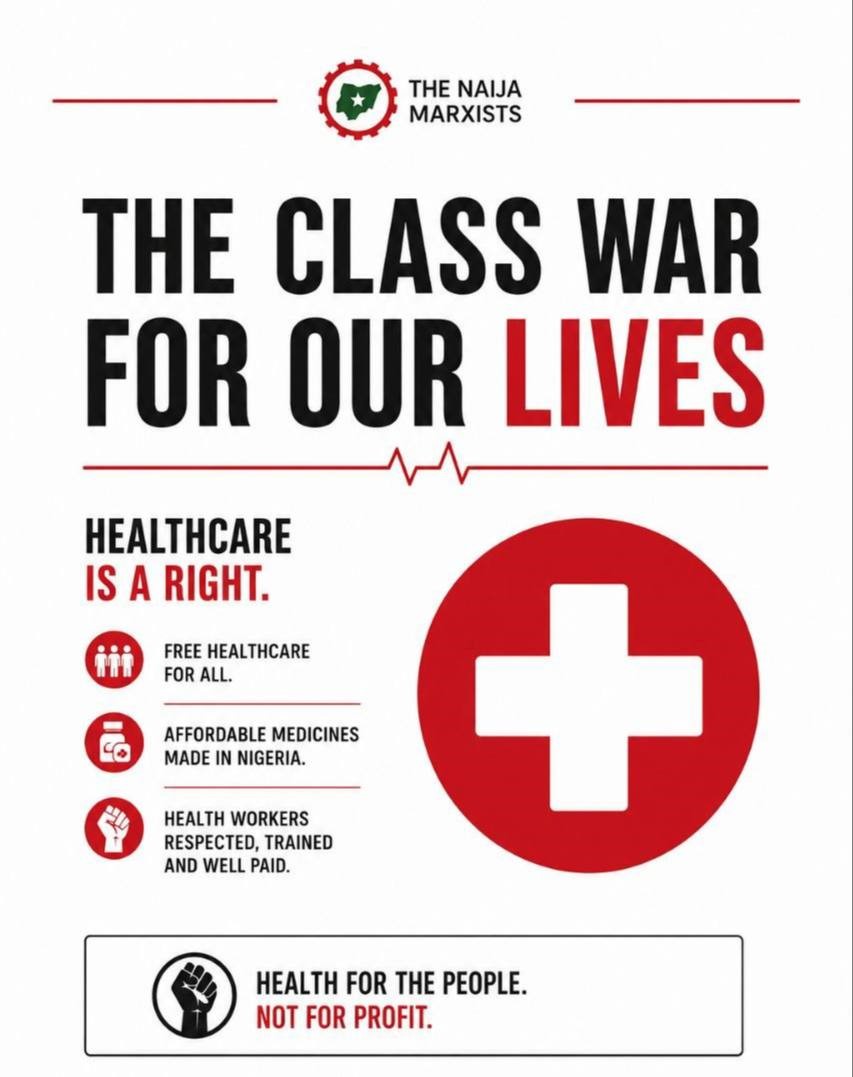
For decades the Nigerian ruling class has promised universal health coverage to the working masses. Through endless summits, reform mandates and empty rhetoric they keep selling a future where every Nigerian reaches essential healthcare without financial ruin, and they deliver nothing. Nigeria put its name to the 1978 Alma-Ata Declaration and swore to bring healthcare to all. Almost half a century later that promise lies in ruins, and the ordinary Nigerian still pays for a fever with money meant for food.
Alma-Ata: The Promise Signed and Abandoned
In the late 1970s the world’s medicine carried an obscene, neocolonial contradiction. Citizens in wealthy Western capitals enjoyed high-tech tertiary care while millions in the Global South died of diarrhoea, measles and malnutrition, illnesses that a working clinic could stop. Out of that outrage the world convened in 1978 in Alma-Ata, then capital of Soviet Kazakhstan, and set the goal of health for all by the year 2000. The declaration named health a fundamental human right and made primary health care its foundation, “essential health care… made universally accessible to individuals and families in the community through their full participation and at a cost that the community and country can afford to maintain”.
The promise was betrayed almost at once. UNICEF and the Rockefeller Foundation pushed selective primary healthcare in place of the comprehensive model agreed at Alma-Ata, breaking a whole system down into narrow, disease-specific programmes that were expensive and therefore lucrative for the interests behind them. When global oil prices crashed in the 1980s, Nigeria swallowed the Structural Adjustment Programmes demanded by the IMF and the World Bank to unlock foreign loans. Austerity became law, public spending was slashed to service debt, and because the rulers treat healthcare as an unproductive cost it was cut first. Rural health funding dried up outright. Clinics decayed into empty buildings without diagnostic tools, clean water or electricity, and routine immunisation and health education collapsed while epidemics returned.
In 1993 the World Bank published Investing in Health and seized command of global health policy from the World Health Organization, rewriting medicine as a market governed by cost-effectiveness and individual responsibility. Nigeria’s rulers built the cash and carry system, forcing patients to buy their own drugs, syringes and gloves before a nurse would touch them, and out-of-pocket spending exploded as the sick were driven into poverty. The African Union met in Abuja in 2001 and pledged 15% of national budgets to health, yet Nigeria has never once honoured its own promise. The World Trade Organization then locked in TRIPS, handing multinational drug companies at least 20 years of monopoly over lifesaving medicines, the very opposite of the affordable essential drugs Alma-Ata demanded.
Why the Reforms Were Always Going to Fail
Every one of these fixes came dressed as progress and every one deepened the crisis, because the problem is not bad policy or bad men in office. Nigeria’s ruling class is a comprador class, a junior partner of foreign capital that lives off importing, contracting and collecting rent while it builds almost nothing. Such a class cannot develop the productive forces a real health system stands on, the drug factories, the training hospitals, the power and water and roads that carry care to the village. It has no interest in doing so, because its wealth flows from keeping Nigeria a market for finished foreign goods and a source of cheap oil and cheap labour. Health insurance, public-private partnerships and the HMO schemes our technocrats now sell change none of this. They funnel public tax money into private Health Maintenance Organizations and insurance cartels, hand public land and hospitals to private firms to run for profit, and price the poorest out entirely. A class that cannot build cannot heal, and no summit will make it otherwise.
What This Means for the Ordinary Nigerian
The ordinary Nigerian pays for this betrayal with money and with life. Around 70% of all health spending still comes straight out of the patient’s pocket, and fewer than one in eight Nigerians carries any health insurance at all. Government health spending sits below 5% of the budget, a third of the 15% the rulers swore at Abuja. Every year medical bills alone push over a million Nigerians into poverty, so that a single hospital admission can wipe out a family’s savings and its future. The country now suffers close to a third of all maternal deaths on earth, more than any other nation, while one doctor is left to cover four to five thousand patients as the rest flee abroad for wages Nigeria refuses to pay. These are not accidents of nature. They are the direct product of a system that treats the health of millions as a cost to be cut!
What Health Would Look Like Under Workers’ Power
Nigeria does not lack the wealth to heal its people, and the proof stands abroad. Cuba, strangled by a decades-long imperialist blockade, built a neighbourhood-based system on the principle that healthcare is a right, and drives infant mortality below that of the United States. Vietnam, a lower-middle-income country, planted commune health centres across almost every community and reached the poorest villages in the mountains, lifting life expectancy to 74. Both poured limited budgets straight into their people while private profit was shut out of medicine.
A workers’ government in Nigeria, holding the commanding heights of the economy, would fight for:
- Free healthcare for all at every level, funded by the public purse, with cash and carry abolished.
- Public ownership of the drug and pharmaceutical industry, breaking the patent monopolies and producing essential medicines at home.
- A fully funded primary health centre in every community, with clean water, power and working equipment guaranteed.
- Doctors, nurses and health workers trained in their thousands and paid to stay, as servants of the people and not commodities for export.
- Democratic control of the whole health system by the workers and communities who use it, from the ministry down to the ward.
None of this is utopian. It is what planning for human need instead of private profit makes ordinary.
How We Get There: Build the Revolutionary Party
The record is clear. The Nigerian comprador ruling class will never deliver genuine healthcare, and no election will shame it into doing so. The working class cannot win this by pleading. It has to take the healthcare system into its own hands, from the health ministry to the drug companies and the hospitals, as part of taking the whole economy out of the hands of the parasites in power.
A class does not seize power without an instrument, and that instrument is a revolutionary party rooted in the workers and the poor, armed with a clear programme and disciplined for the fight. The Naija Marxists are building that party, joining hands with workers across Nigeria to defeat capitalism and build a healthier Nigeria.