The Bloated Nigerian Exchange
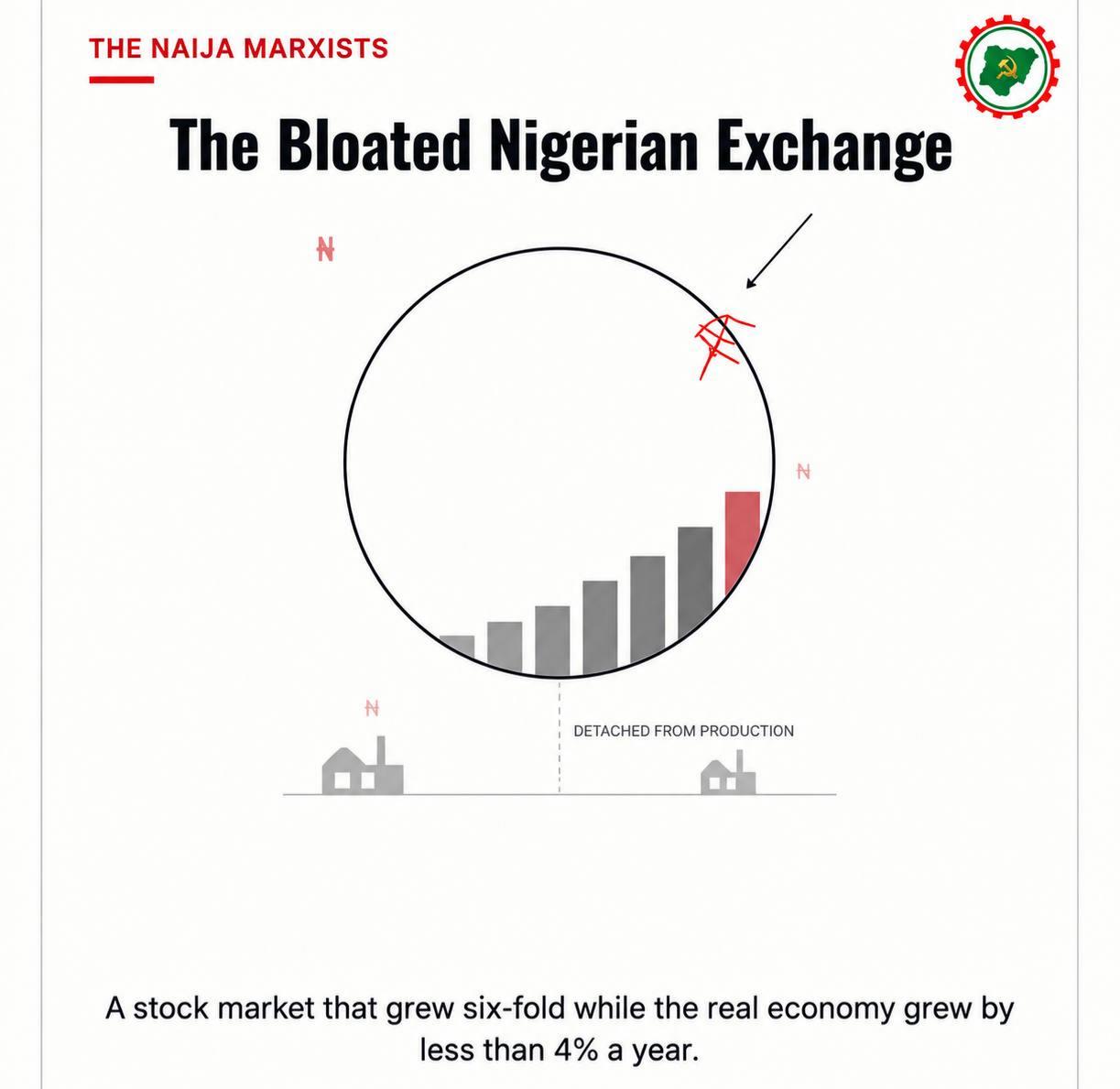
There is no clearer sign to us, and to the doubters, that Nigeria is a capitalist country than what is happening on the floor of the Nigerian Exchange (NGX) right now. In a little over three years, the market capitalization of Nigeria’s listed companies has leapt from under ₦30 trillion in May 2023 to more than ₦160 trillion by May 2026, and is expected to hit ₦225 trillion by the end of Dangote’s IPO sales in October — an almost six-fold rise. In the same period, the real economy that this exchange is supposed to represent grew by less than 4% a year, which is quite contestable because the Tinubu regime crudely manipulated the figures. Food inflation climbed 20%, and nearly two-thirds of the population remain trapped in poverty by the state’s own measurement. What looks like growth is a bubble, inflated on purpose by the Nigerian ruling capitalist class and their imperialist masters.
When the Tinubu regime devalued the naira (floated) in 2023, the currency lost most of its value against the dollar. The economy crashed into recession and even depression level by the end of 2024. The economy only recovered weakly by the second quarter of 2025. This was covered up by the crude “re-basing” of the data to disguise the actual state of the economy. The recovery was due to the international oil market, not the performance of the actual economy itself.
Every price in the country jumped, including share prices, which is actually most of the boom. However, measured in real money and growth, the exchange did not grow at all, as there was no corresponding increase in production in practically all sectors of the Nigerian economy. On the day of the devaluation, the Nigerian Stock Exchange was worth about ₦28.8 trillion ($33 billion), and a year later, in May 2024, after all the celebrated gains, it was worth about ₦56 trillion ($61 billion).
The monopolies in this sector can also raise their prices whenever they please, and they do. Their naira revenues swell, their profits swell, and the market lifts their share prices to match. The worker whose wage buys less each month is the same worker being squeezed to make those profits.
A Market Detached
Nigeria’s nominal GDP for the second quarter of 2026 stood at roughly ₦119 trillion. The stock exchange, in the same period, was already worth more than the entire annual output of the country, several times over. In other words, the shares of a few hundred companies are now priced higher than everything the whole country produces in a quarter, even though those same companies employ only a sliver of Nigerians and make only a fraction of what the country actually grows, builds, and sells. What this market measures is speculation: money chasing money, detached from factories, farms, or wages, feeding on itself. Nigeria now has one of the fastest growing speculative sectors (a casino economy) in the world.
And this money is concentrated in very few wallets. Twenty-four companies, out of roughly 147 listed on the entire exchange, control nearly 75% of its total value. Nine of those companies alone, the so-called “megacaps,” account for over half of that concentrated wealth. Eight familiar names hold nearly two-thirds of everything traded on the exchange: Aliko Dangote’s cement, the telecom giants MTN Nigeria and Airtel Africa, and the tier-one banks now forcibly consolidated by the state’s own recapitalization order — Zenith, GTCO, Access, and United Bank for Africa. There is no market of small investors and honest enterprise here. It is a fortress held by a tiny caste of monopolists, protected by licence, by political connection, and now by the deliberate hand of the Central Bank itself, which forced banks to quadruple their capital and swallow their smaller rivals whole. This is the ruling capitalist class plainly making itself richer through manipulation, rather than real production, carried out in full view.
The Mirage of the “Trillion-Dollar Economy”
A company’s market value is only its last share price multiplied by every share it has, including the huge majority that nobody is buying or selling. A few small trades in a handful of giant stocks can raise the reported value of the whole market by trillions while not one naira changes hands. If the big holders all tried to sell at once, there would be no buyers and the price would fall through the floor. The ₦59 trillion the papers say was gained is only a number on a screen that nobody can walk into a bank and withdraw.
This is not a new performance, as Nigeria has done this trick before. In 2014, under Goodluck Jonathan, the National Bureau of Statistics rebased the country’s GDP calculation and announced, overnight, that Nigeria’s economy was 89% larger than previously measured, enough to overtake South Africa and become “Africa’s largest economy.” Nothing had been built, no factory had opened. The change was a recalculation of categories on a spreadsheet, yet Jonathan stood before the nation and called it “a collective achievement of all Nigerians.” A year later he lost the election anyway, because a spreadsheet does not put food on a table, even if statisticians told them otherwise. Conspiracy commentators, like David Hundeyin, have since insisted that the “West” removed Jonathan by hidden hand precisely because Nigeria was “booming” under him. To claim the CIA removed Jonathan for growing the economy, you must first believe the economy grew — and it did not.
The same operation is running again today, only this time through the stock exchange. The market capitalization is portrayed as proof that Tinubu’s government has multiplied the size of the economy since 2023. It has multiplied nothing but the paper value of shares held by two dozen firms, i.e., the capitalists and ruling class of Nigeria.
What This Bubble Means for Ordinary Nigerians
While the stock exchange doubles and doubles again, the National Bureau of Statistics’ own figures show that 63% of Nigerians — 133 million people — are multidimensionally poor, and that more than two-thirds of Nigerian children live in that poverty. The banks in Nigeria and their shares soar on the back of forced recapitalization, yet food inflation has run above 20% for months on end, with staples like rice and yam more than doubling in price since 2023. The ruling class talk of a “trillion-dollar economy,” but they are the same people who redefined one hour of work a week as a job, dropping the jobless rate from 33% to 4% without creating any jobs. Ninety-two percent of working Nigerians survive in the informal economy, with no contract and no protection. Over thirty million Nigerians face acute food insecurity this year. This is the real Nigerian economy.
This is simply a symptom of capitalism deep in crisis. It does not need the productive economy to grow in order for a handful of monopolists to grow richer; it only needs control over banks, cement, telecoms, and the regulatory power of the state to concentrate existing wealth into fewer hands, then announce the concentration as prosperity. Why does the surplus go into paper instead of factories? Because a population this poor cannot buy what new industry would make, so producing for profit no longer pays. Capital stops building and retreats into shares, government paper, and the currency spread, where it can grow without producing anything at all.
Every trillion added to the NGX is a trillion that could have built real industry, hospitals, schools, and wages, instead sitting as a paper claim in the accounts of Dangote, MTN, Airtel, and a cartel of banks.
What is certain is this fictitious bubble will inevitably burst. It is only a matter of time. Once the market capitalization exceeds GDP, it is a sign of serious structural imbalance in a capitalist economy. While that is not projected to happen this year, it is on the agenda, as the casino economy grows rapidly.
The Mirage Will Not Save Them
Nigerian working masses cannot afford to mistake this stock exchange for the nation’s fortune. It is not our fortune. It belongs to a small number of families and firms who call it national growth for as long as the bubble holds. Nigerians already tried to fix this by changing the government, voting Jonathan out in 2015. That reform changed nothing. Swapping one set of rulers for another inside this rotten system only changes who signs the agreements. It leaves the system underneath untouched.
There is no reformist path through this huge crisis. A market this concentrated, this disconnected from production, resting on a population this impoverished, will not correct itself through a change of president, a new central bank governor, or another statistical rebasing. It will only be resolved when the working people and the poor of Nigeria organise to seize the productive wealth these monopolies have concentrated, and place it under their own control, to be run for food, wages, and need, rather than for the share price. The Nigerian Stock Exchange mirage is not a sign of Nigeria’s rise, but a sign that only a revolution can give Nigerians the national prosperity they seek.