Tinubu's State Police Bill: A Cheap Distraction, Not Security
Nigeria is bleeding. Farmers pay levies to armed groups. Highways are kidnapping markets. Food inflation is above 40%. Unemployment is over 33%. And the Tinubu administration’s answer is a State Police Bill. This is not surprising, as the call for state policing is not a new issue. Bola Tinubu has always advocated for the creation of state police since the beginning of Nigeria’s Fourth Republic in 1999. This longstanding position has now moved to the centre of national discourse following the recent constitutional amendment on state policing passed by the senate.
Why was this Tinubu bill hurriedly put together now?
The answer to this question is that when the Nigerian ruling class has no answer for poverty, they offer police. When they have no answer for hunger, they offer police. When they have no answer for the political crisis they created, they offer more police.
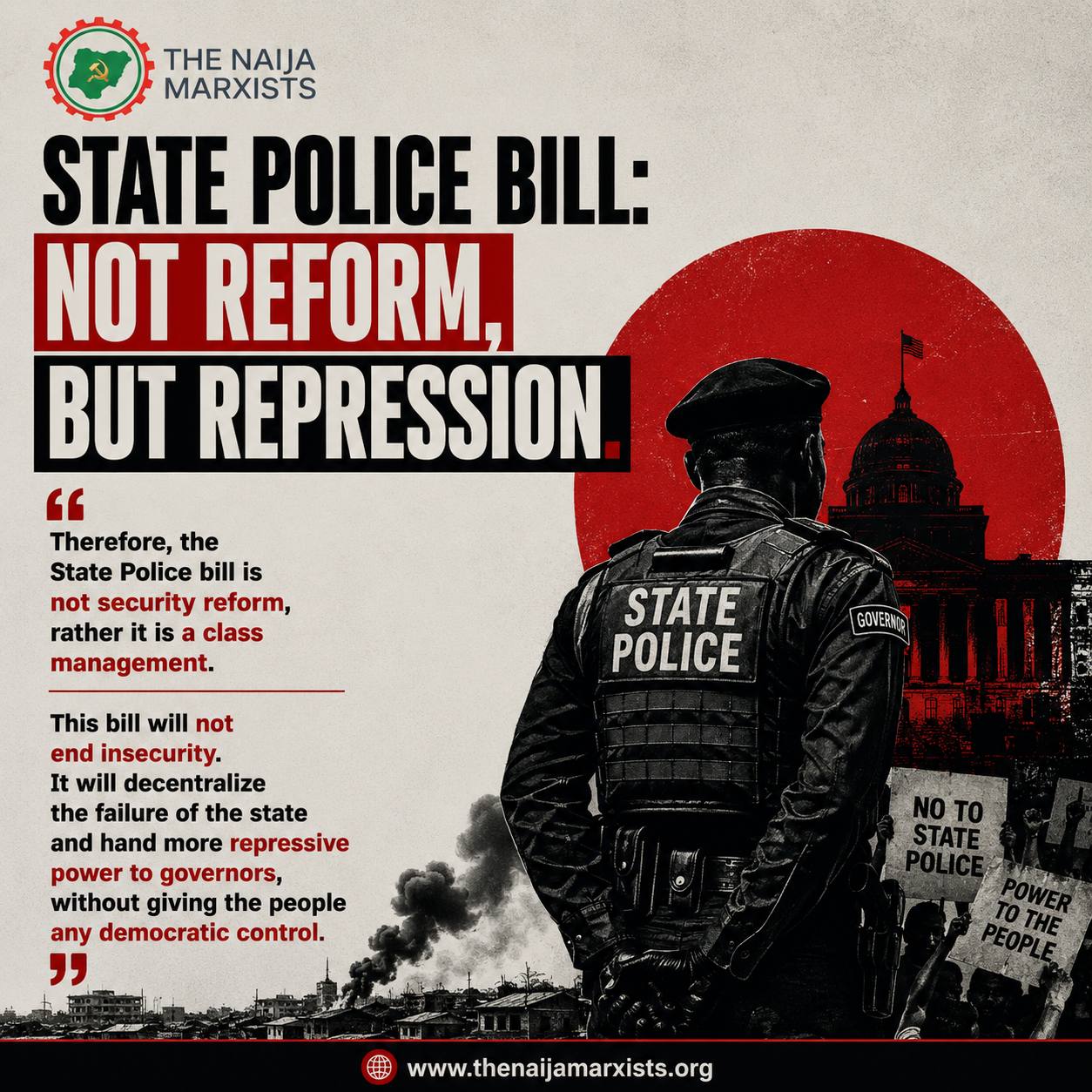
Therefore, the State Police Bill is not security reform; rather, it is a tool of class management. This bill will not end insecurity. It will decentralize the failure of the state and hand more repressive power to governors, without giving the people any democratic control.
STATE POLICE: THE MATERIAL BASIS OF THE “DISTRACTION”
To understand this bill, it is important to ask a pertinent question: what problem is this bill actually trying to solve?
Since coming to power, the Tinubu administration has overseen a sharp devaluation of the naira, which has lost more than 440 percent of its value against the US dollar. The pump price of petrol has risen by over 600 percent, while electricity tariffs, port charges, and the prices of many essential goods and services have also increased significantly. These policies have triggered soaring inflation, declining real wages, and a severe cost-of-living crisis.
At the same time, the country’s security situation has continued to deteriorate. Incidents of banditry, kidnappings, insurgent attacks, and communal violence remain widespread across many parts of Nigeria. New armed groups continue to emerge, while kidnapping for ransom has reached unprecedented levels.
This worsening insecurity is closely linked to the deepening economic hardship, rising unemployment, and mass poverty intensified by the Tinubu administration’s economic policies, which are the prescriptions of the International Monetary Fund (IMF) and the World Bank.
Therefore, from a ruling class perspective, there are two problems in Nigeria today.
The first is the economic crisis, which manifests in the form of price hikes, devaluation, and IMF policies that have created mass poverty, brewing pent-up anger and resistance.
The second is the security crisis, in which banditry, kidnapping, and terrorism have made large parts of the country ungovernable. This threatens profits, investment, and state legitimacy.
The continuous occurrence and reproduction of these problems show that the ruling class cannot solve them without reversing their anti-people economic policies. Such policy reversal would hurt capital and foreign investors. So, the ruling class focuses on the problem, not to solve it but to manage it.
In this way, state police is a management tool, not a solution.
As a management model, state police does three things for the ruling class:
First, it shifts blame. Instead of emphasizing that “our economic policies caused this,” their narrative becomes “the police structure caused this.”
Second, it shifts power. This means transferring more coercive power to state governors and the executive, with less pressure to deliver material needs (security) at the federal level.
Third, it costs less politically. Creating jobs for the teeming population of unemployed graduates in Nigeria costs money and threatens profits. But buying police uniforms for a few thousand police officers is cheaper.
This is not a conspiracy. This is how capitalist states work in crisis: when you cannot address the root, you expand the repressive arm.
IF CENTRALIZED POLICE FAILED, 36 WEAKER SYSTEMS WILL FAIL MORE
The first is to address material conditions such as the unemployment crisis, living wage, agricultural investment, and land reform. No society has policed its way out of poverty.
The second is the creation of democratic community control. A democratic approach to policing requires that security institutions are accountable to the communities they serve rather than being controlled solely by political executives or powerful individuals.
Creating democratic community control over policing would involve establishing structures through which citizens have a meaningful role in setting priorities, monitoring police conduct, and ensuring accountability. Such a system would require independent community oversight bodies made up of representatives of workers, residents, civil society organisations, traditional communities, and other stakeholders. These bodies would monitor police operations, receive complaints, review misconduct allegations, and ensure that policing priorities reflect the genuine security needs of communities.
A democratic approach to public safety requires the creation of elected and recallable Community Safety Boards that are directly accountable to the people they serve. These boards should include representatives of workers, students, women, civil society organisations, and other community stakeholders to ensure that policing priorities reflect the needs and concerns of ordinary citizens. The funding for these structures should come from the federal government to guarantee adequate resources and prevent poorer communities from being disadvantaged. However, operational control and oversight must remain with the communities themselves, not with state governors or political executives. Such a model would create a system of democratic accountability where communities have a meaningful role in monitoring security institutions, setting local priorities, and ensuring that public safety agencies protect citizens rather than serve political interests.
The final suggestion is the dismantling of the thug system. Ending insecurity in Nigeria requires confronting and dismantling the networks of political thuggery that have been sustained by sections of the political establishment for decades. Thug groups do not emerge in isolation; they are often created, funded, and mobilised as instruments of political control, electoral manipulation, intimidation, and suppression of opposition.
In this way, there should be specific laws targeting and prosecuting politicians who arm youths. There should be a programme for disarmament, demobilization, and reintegration for ex-combatants.
CONCLUSION: REJECT THE TRICK, DEMAND THE REAL SOLUTION
The State Police Bill is a ruling class answer to a ruling class crisis. The intention of the bill is to shift blame from economic policy to police structure. The implication of the bill is the shifting of power to governors without shifting power to the people.
By using American state police as a model, the bill copies the repressive parts of other systems and rejects the democratic parts. Consequently, there is a risk that it could be used not only to police crime but also to keep the majority of the population, including the working class, under control, suppress political opposition and dissent, and preserve the existing balance of power, rather than addressing the structural causes of Nigeria’s security crisis.
The SIEC example proves that decentralization without democracy is decentralization of abuse. The funding and capacity crisis prove that 36 weak forces will be weaker than one weak force.
Nigerians do not need another layer of repression. We need bread, jobs, land, and justice. We need security that is controlled by communities, not by executives.
Reject this bill. Demand a program that starts with the material needs of the people.