Multipolarity v US Hegemony: The Prospects for Africa
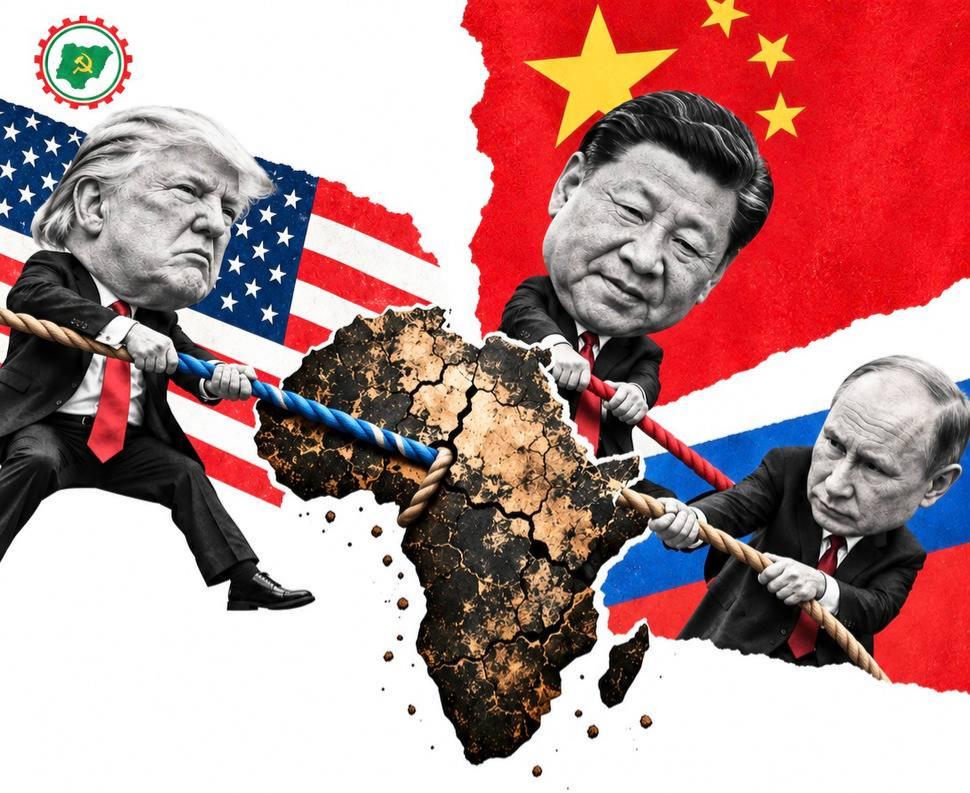
For a generation that has witnessed incessant wars, sanctions, economic coercion, military interventions and political interference associated with the United States and its allies, the growing appeal of a multipolar world among African youth is not so difficult to understand. If American hegemony has contributed to the conditions under which many countries of the Global South have struggled to exercise economic and political independence, then surely the emergence of alternative centres of power must offer the possibility of something better.
There is a real material grievance behind this hope, but also some dangerous assumptions. Some insist that the redistribution of geopolitical power is equivalent to a transformation of the economic relations that produce the already existing exploitation and dependency. Others agree that exploitation and dependency will persist, but cling to the thread that the alternatives appear less belligerent, hence a multipolar order would be less chaotic and more peaceful than the status quo.
We must first concretely establish that a world with several competing powers is not equivalent to a world without imperialism. And this world is NOT the only alternative.
What is imperialism?
Imperialism is capitalism at a stage where enormous companies, banks and financial institutions have accumulated such wealth and power that they dominate whole industries, markets and increasingly entire economies. Rather than simply selling goods abroad, these powerful interests also export capital, investing in foreign mines, factories, banks, infrastructure and industries to secure profits and control resources.
These investments are not merely economic transactions. They create relationships of power between countries, backed by the political, financial and military strength of the states from which the capital originates. The biggest capitalist powers compete to control markets, resources, investment opportunities and strategic territories. This is what is described as the monopoly stage of capitalism.
But capitalism develops unevenly. Some countries grow faster than others, and the balance of economic power changes. The problem is that the division of the world’s markets and resources reflects an earlier balance of power. As new capitalist powers rise, they demand a greater share, bringing them into conflict with those already dominating the world economy. Imperialism is therefore not simply American aggression or European interference. It is rooted in capitalism itself. Any capitalist power that develops sufficiently can begin to compete for markets, resources and spheres of influence, regardless of its history or anti-Western rhetoric.
This distinction is essential to understanding the rise of China, Russia and other powers challenging American dominance.
The rise and relative decline of the old powers
History itself demonstrates how the balance of imperialist power changes. The United States began as thirteen British colonies and declared independence in 1776. By around 1890 it had become the world’s largest economy. Britain’s share of world manufactured exports, meanwhile, fell from around 45% in 1875 to 30% by 1913 and 5% by 1994. The former colony overtook its coloniser and took its place at the head of the imperialist system. Winning independence placed power in the hands of an American capitalist class, which then expanded abroad as every capitalist class must.
That dominance is now in relative decline. In 1989 the countries of today’s EU and Britain together produced 27.8% of world output at purchasing power parity, the US 22.2%, and China 4%. Thirty years later, Europe and Britain had fallen to 16%. By 2025 the US share was 14.7%, against 19.6% for China. The transformation is even clearer in manufacturing. The United States accounted for roughly 28% of global manufacturing output in 2001, falling to 17% by 2023, while China’s share rose to around 30%. Even the dollar’s dominance has weakened, with its share of global foreign exchange reserves falling to approximately 56.8% by the end of 2025. Yet relative decline does not mean that the old imperialist powers have surrendered their economic dominance.
| 2024 | Trade with Africa | FDI stock in Africa |
|---|---|---|
| EU | €356bn | €205bn (2023) |
| China | €273bn | €39bn (2023) |
| US | €67bn | €46bn |
Source: ITC Trade Map, in EUISS Brief 4/2026.
These figures reveal an important distinction between trade and the ownership of capital. Although China has rapidly expanded its commercial relationship with Africa, European investors still hold substantially more direct investment stock on the continent.
The contest is therefore not occurring on an empty playing field. The rising powers are competing for influence in a world whose markets, resources and investments are already deeply shaped by the old imperialist powers.
This brings us to the supposed alternatives.
Who are the alternatives?
BRICS now includes China, Russia, India, Brazil, South Africa, the UAE, Iran, Egypt, Ethiopia and Indonesia. Saudi Arabia was invited in 2023 and has still not formally joined. Yet multipolarity is often presented as though they constitute a unified anti-imperialist bloc. They do not. These countries have different economic structures, ruling classes and geopolitical interests. Their common desire for greater influence within international institutions does not eliminate competition between their own capitalist classes.
To understand what they offer Africa, we must examine their actual economic relationships with the continent rather than their diplomatic declarations.
China: an alternative to the West, but an alternative of what class?
China is Africa’s largest single trading partner, and the exchange follows the old pattern. Africa sends crude oil, copper, cobalt and iron ore, and receives finished goods. In 2025, Africa’s trade deficit with China increased by 64.5% to approximately $102 billion. Meanwhile, Africa accounts for only a tiny share of global manufacturing output. The problem is not simply the trade deficit, but the continued division of production in which African economies supply raw materials while importing higher-value manufactured products.
Chinese finance undoubtedly offers African governments additional choices. Loans, infrastructure investment and access to Chinese markets can provide alternatives to Western institutions, sometimes improving governments’ bargaining positions.
But alternatives for whom?
Who owns the mines and factories? Who controls the profits? What happens to the workers employed in them? How much value remains within African economies, and who ultimately determines how that value is distributed? Greater room for manoeuvre for an African state is not equal to greater power for African workers. An African ruling class can negotiate a more favourable arrangement with Chinese capital while leaving domestic exploitation untouched. We see this every day.
But what does Chinese finance actually mean for Africa? Consider Angola, which received approximately $49 billion in Chinese loan commitments between 2000 and 2024, much of it secured against oil revenues, a system crudely called the “Angola Model”. Part of the country’s future oil income is therefore tied to debt repayments. In the DRC, which produces nearly three-quarters of the world’s cobalt, Chinese companies control 68% of the Sicomines mining venture, leaving the Congolese state with 32%. In exchange for access to copper and cobalt, billions in infrastructure were promised, yet only $825 million of the initial $3 billion had been disbursed by the end of 2020. Even after renegotiations in 2024, Chinese companies retained their majority stake. Congo supplies the minerals, but foreign capital retains control of the venture and much of the wealth it produces.
The consequences extend beyond debt and ownership. In February 2025, a dam operated by Chinese-owned Sino-Metals collapsed in Zambia, releasing acidic mining waste into the Kafue River system, contaminating water and destroying livelihoods.
What connects these examples? African governments negotiate the loans and concessions, foreign capital gains access to resources and profits, while workers and communities bear much of the economic and environmental cost. An alternative source of finance is not necessarily an alternative to exploitation.
Russia’s place in the emerging order
In 2025, Africa accounted for only 3.9% of Russia’s trade turnover, yet Russian influence increasingly rests on military power and access to African resources. In the Central African Republic, Wagner forces arrived in 2018 to protect the government, but subsequently took control of the Ndassima gold mine, valued at $2.8 billion, through a Wagner-linked company. Local miners were reportedly killed and communities displaced. In Mali, a 2022 military operation at Moura involving Malian troops and foreign personnel left more than 500 people dead, according to the UN.
Madagascar shows how this influence develops in real time. After the military seized power in October 2025 during the Gen-Z Revolution, its new leader, Michael Randrianirina, made his first official foreign visit to Moscow. Russia followed with helicopters and humanitarian aid in February 2026, then armoured vehicles and military equipment in April, while Russian personnel helped protect the president. Madagascar is rich in graphite and occupies a strategic position along the Mozambique Channel. As Moscow strengthens its military relationship with the junta, the same government has arrested young activists whose protests over water and electricity helped bring it to power. Once again, the interests of a foreign power and an African military government advance together, while the masses who fought for change remain excluded from power.
Ultimately Russia’s appeal draws partly on the Soviet Union’s support for African liberation struggles. But the Soviet Union rested on nationalised property and a planned economy, while the privatisations of the 1990s created a new Russian capitalist class. The guns protecting Russian interests in African gold are not instruments of liberation, whatever the Kremlin says about Western imperialism.
The UAE: a revealing case
The UAE offers another example. By 2024, it had approximately $60 billion invested across Africa in ports, energy, logistics and agriculture. Yet it is also a major destination for illegally exported African gold. SwissAid estimated that more than 435 tonnes of gold were smuggled out of Africa in 2022, most of it destined for the UAE, depriving African states of potential public revenue.
In Sudan, UN investigators found credible allegations of Emirati weapons transfers to the Rapid Support Forces through Chad, which the UAE denies. The RSF and allied militias have been implicated in mass atrocities in Darfur. Here, investment, resource extraction and geopolitical influence intersect, while African populations bear the consequences. Capital does not cease to pursue profit and power simply because it comes from Abu Dhabi rather than Washington.
What does multipolarity actually offer Africa?
Competition among several centres of capital lets governments diversify their finance and bargain for better terms. An African government with five investors competing for its minerals may strike better deals than one with a single buyer. But better terms do not necessarily mean a transformation of the underlying economic relationship. Between 2021 and 2023, 46 of Africa’s 54 countries remained dependent on commodity exports. Higher prices for copper, oil or cobalt may increase government revenue and capitalist profits, but they do not automatically change the position of the workers extracting those resources.
An African capitalist may benefit enormously from competition between Chinese, European and Emirati investors while African workers remain poorly paid, their economies dependent and their governments indebted.
Nor does multipolarity guarantee peace. Before the First World War, Germany’s industrial strength had grown rapidly. In 1912, it produced approximately 17.6 million tonnes of pig iron compared with Britain’s 9 million, yet Britain retained an enormous colonial empire. Germany’s growing economic power confronted an international division of markets and territories established when Britain was stronger. That disparity was ultimately settled by world wars.
Today, the relative decline of the United States and the rise of China are generating new economic and geopolitical confrontations. The tariff conflict intensified by Washington in 2025 is one manifestation of that competition.
This does not mean that war between the United States and China is inevitable. But a more evenly distributed balance of capitalist power does not eliminate the struggle for markets, profits and resources. It can intensify that struggle. Africa’s resources, markets and strategic position are inevitably drawn into these rivalries.
The question is therefore not merely whether a multipolar world gives African governments more options. It is whether those options can overcome the class relations that have sustained exploitation and dependency.
Beyond choosing an imperial centre
The history of the United States holds a lesson for Africa. A former colony became the centre of world imperialism once its own capitalist class grew strong enough. African states won political independence in the 1950s and 1960s without economic sovereignty, and their ruling classes, Nigeria’s among them, take their share by managing that dependence for whichever foreign capital pays best. Exchanging Washington for Beijing, Moscow or Abu Dhabi changes the bidder but does not end the auction.
The alternative to US hegemony cannot simply be another arrangement in which African societies remain objects of competition between powerful states and capitals. The deeper question is who controls Africa’s productive forces and in whose interests they are developed. For the ordinary Nigerian worker, that means control over natural resources, democratic control over investment and production, industrialisation oriented toward social needs rather than external accumulation, and political power capable of challenging both foreign domination and the domestic ruling class that profits from it.
The desire among young Africans to see American domination challenged is understandable and rooted in real historical grievances. But that desire must go beyond replacing one capitalist power with another.
Africa does not need a new master in a multipolar world. It needs liberation from the capitalist relations that make foreign domination possible in the first place.
The struggle must therefore go beyond the redistribution of imperialist power towards the revolutionary transformation of society itself.
Beyond multipolarity, for a communist Africa!