Internationalism Against a Fracturing World
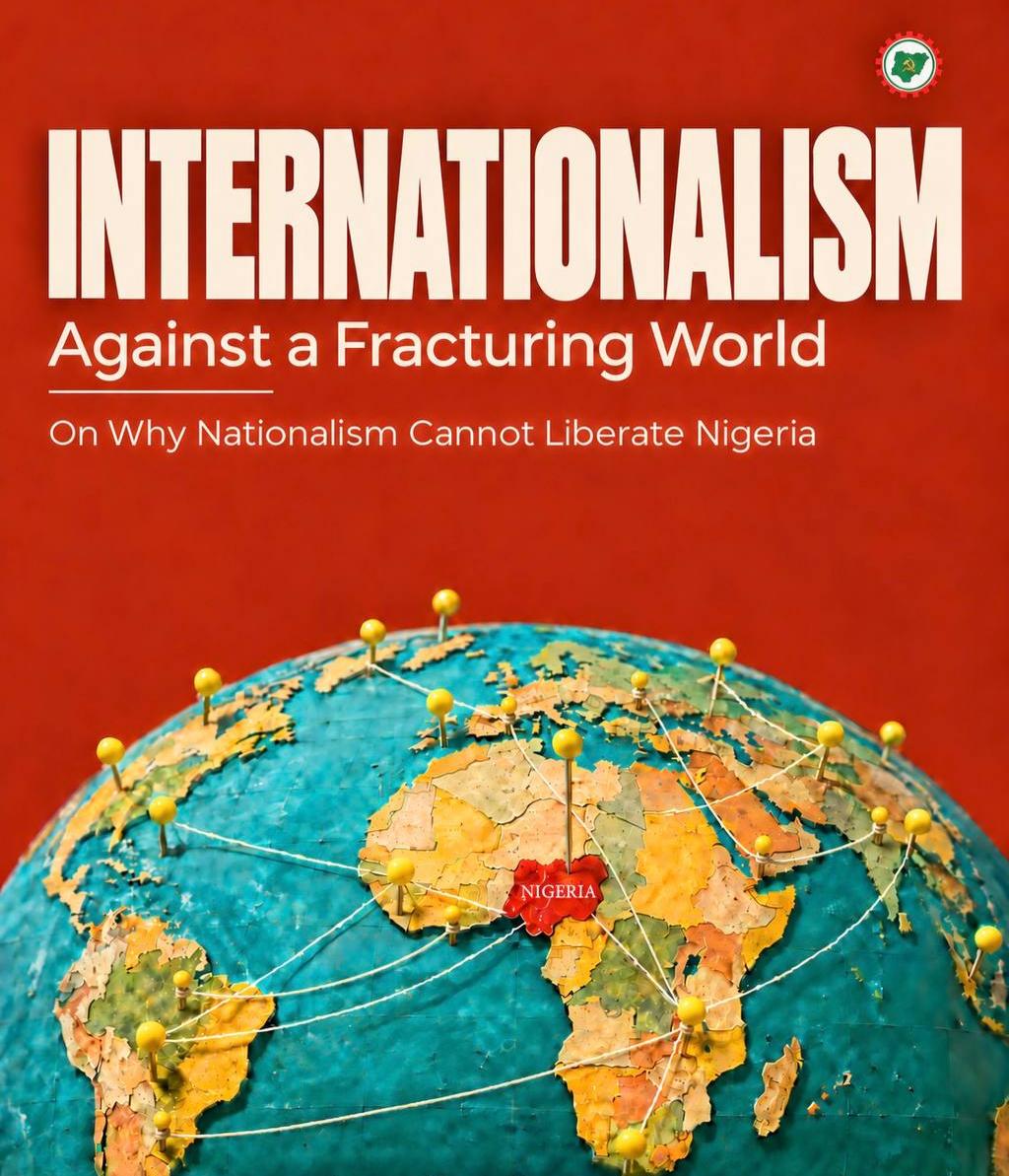
The world is entering a period of sharpened internationalist struggle: wars, sanctions, debt crises, migration regimes, climate shocks, and renewed rivalry among imperialist and regional powers are colliding with working-class resistance from Lagos to Gaza, Khartoum to Port-au-Prince. For global capitalism, this is not merely instability; it is a crisis of its post-1990 order. For Nigerians, this means that the fight against hunger, insecurity, debt, fuel-price increases, and authoritarian policing cannot be separated from the international struggle against imperialism and capitalist exploitation.
The Return of Internationalist Struggle
Internationalism is not an abstract slogan but the recognition that capital organises globally (through finance, supply chains, technology, debt, military alliances, and institutions such as the IMF and World Bank) while workers and oppressed peoples are told to fight only within national borders. Our own starting point is that Nigerian capitalism is a local expression of a global system of exploitation, and that Nigerian liberation is bound up with African and international working-class liberation!
Today’s struggles are internationalist because their causes and consequences cross borders. The wars in Ukraine, Palestine, Sudan, and the Sahel; the competition over semiconductors, rare earths, oil, gas, and shipping routes; the debt crises of Africa, Asia, and Latin America; and the climate emergency all express the same underlying contradiction: a global system that must continually expand profit while producing inequality, war, ecological destruction, and social breakdown.
The old claim that “globalisation” would lift all countries into prosperity has collapsed. Instead, many states in the Global South remain locked into exporting raw materials, importing manufactured goods and technology, borrowing in foreign currencies, and accepting austerity as the price of survival. This is why Marxists who are worth their salt have long argued that globalisation is not neutral integration but a contemporary form of imperialist domination!
What It Means for Global Capitalism
Global capitalism is undergoing a structural crisis of leadership and legitimacy. The relative stability of the post-Cold War era (built around US military power, the dollar system, Western-controlled financial institutions, and expanding global trade) is under strain from China’s rise, regional powers asserting autonomy, sanctions wars, protectionism, and the growing refusal of many states to accept unconditional alignment with Washington.
But this is not simply a contest between “the West” and “the rest.” A multipolar world does not automatically mean liberation for workers. BRICS states, Gulf monarchies, and regional powers can pursue their own national-capitalist interests while still exploiting workers, suppressing dissent, and extracting value from weaker economies. The central division is not between nation-states as such, but between the capitalist class internationally and the working class, peasants, urban poor, and oppressed peoples who produce the world’s wealth.
Capitalism responds to crisis through three main methods:
- Austerity and debt discipline, forcing governments to cut public spending, devalue currencies, remove subsidies, and open economies to foreign investors.
- Militarisation and war, securing access to resources, trade routes, markets, and political influence.
- Nationalist division, encouraging workers to blame migrants, minorities, rival nations, or religious groups rather than the system that immiserates them.
These methods are visible across the world. They are also visible in Nigeria, where the removal of fuel subsidies, currency devaluation, inflation, debt servicing, rising ethnic and tribal divisions and security spending have placed the burden of crisis squarely on workers and the poor.
The Nigerian Condition
Nigeria is not outside this global struggle; it is actually one of its sharpest expressions. The country’s dependence on oil exports, imported refined fuel, foreign loans, imported food and machinery, and dollar-denominated debt makes it especially vulnerable to global price swings, currency pressures, and the policy demands of international creditors. We have historically understood the country as capitalist and integrated into the world economy, but shaped by neocolonial dependence and local ruling-class interests.
The cost-of-living crisis has made this concrete. Fuel-subsidy removal, naira devaluation, food inflation, unemployment, electricity insecurity, and rising debt-service costs have produced anger among workers, students, market traders, and poor communities. Protests under the slogan “We are hungry!” reflect not merely dissatisfaction with a particular government, but a deeper revolt against a social order in which wealth is produced by the many and controlled by the few.
At the same time, the Nigerian state responds with the familiar tools of capitalist crisis management: repression, appeals to patriotism, sectarian and tribal division, and promises that sacrifice today will bring investment tomorrow. But sacrifice is not shared equally. Ordinary Nigerians pay through transport fares, food prices, school fees, hospital bills, and insecurity, while banks, contractors, oil companies, political officeholders, and international creditors protect their returns.
Why Nationalism Cannot Liberate Nigeria
The ruling class offers Nigerians competing nationalisms: some call for loyalty to Western powers, others for alignment with China, Russia, or a vague “Global South.” None of these offers a path to emancipation. A Nigerian government can change its foreign patron without changing the class relations that keep workers poor, peasants indebted, women oppressed, and youth unemployed.
The lesson of internationalism is that Nigerian workers should not identify their interests with Nigerian capitalists, foreign investors, or any imperial bloc. Their allies are Nigerian workers and poor communities; African workers fighting debt and dictatorship; Palestinian, Ukrainian, Russian, Sudanese, and Congolese workers resisting war and dispossession; and workers everywhere confronting the same system. Solidarity with Palestine, opposition to imperialist war, support for migrants, and defence of democratic rights are not separate from Nigerian politics; they are part of the same fight. Workers across the world face a common system, even though their immediate conditions differ.
This does not mean ignoring Nigeria’s specific demands. We must fight for wages that rise with inflation, affordable food and transport, public ownership of major industries under workers’ democratic control, cancellation of unjust debts and an end to police and military repression. We must also reduce Nigeria’s dependence on oil through planned industrial development that protects the environment. But these demands must be fought for through independent working-class organisation, not through faith in any section of the ruling class.
Our Task
The task is to build an internationalist movement from below. That means organising in workplaces, universities, markets, communities, and online spaces; connecting local struggles over wages, fuel, rent, security, and education to the global struggle against capitalism; and refusing every attempt to divide workers by ethnicity, religion, gender, nationality, or migration status. The internationalist struggle today is therefore a struggle for a different world order: not a new set of masters, but democratic control of production, finance, technology, and the state by the working majority. For Nigerians, the slogan remains clear: neither Washington, Beijing, Moscow, nor the local ruling class; workers of the world, unite!