Democracy or Power? The Class Lessons of June 12
Every June 12, the parasites who loot this country’s treasury gather from Aso Rock to the local government secretariats to perform a ritual called Democracy Day. Men who fought the dictatorship share the podium with men who served it, and all of them invoke MKO Abiola’s name like a charm while the common man and worker who marks the holiday stands in a fuel queue.
There is a deliberate burial of the real history of 1993 in this ceremony, because that history carries lessons the ruling class needs us Nigerians to never learn: the workers of Nigeria have the power to stop begging for “good governance” and start seizing power.
The events of 1993 to 1999 contain, in concentrated form, the central questions of Nigerian politics: the class character of the state, the limits of bourgeois democracy, the role of the labour bureaucracy, and the consequences of mass struggle without a revolutionary party.
The Material Foundation: Structural Adjustment
We cannot understand June 12 without understanding what happened in 1986. That year General Babangida, acting as errand boy for the IMF and the World Bank, imposed the Structural Adjustment Programme and devalued the naira, removed petroleum subsidies, sold off public enterprises and threw thousands of workers onto the street so that foreign creditors could be paid.
Between 1986 and 1989 inflation rose from 5.4% to 40.9% while real wages collapsed and hospitals and schools rotted. The regime called it economic medicine but it was simply the reorganisation of Nigeria’s dependent capitalism on conditions set by international finance, with the full cost loaded onto workers and peasants.
Seven years of this programme produced a crisis of legitimacy for the military state, and the famous transition programme existed to manage that crisis. Babangida manufactured two parties from above, the SDP and the NRC, wrote their manifestos, funded their offices and banned all politics outside them. The arrangement gave the working class no party of its own. It gave Nigeria two faces of the same dependent bourgeoisie competing to administer the same economy.
The Vote as a Weapon of the Hungry
Fourteen million Nigerians voted on June 12, 1993, and Abiola of the SDP won. Abiola was a business mogul, a friend of generals, a capitalist politician through and through, and the millions who queued for him knew it, yet the scale of his vote cannot be explained by his person or his programme.
After seven years of SAP, the ballot was the only weapon left in the hands of the common man, and they used it against the regime and against eight years of suffering. However, because no workers’ party existed, i.e., no independent working class political organisation, that mass anger had to flow through the narrow channel of bourgeois electoral politics and attach itself to a rich man promising farewell to poverty.
The Annulment Was Class Power in Action
The annulment of June 23, 1993 is usually explained as the decision of one general, but this is a narrow interpretation of history.
Nigerian capital in 1993 was at war with itself. The military-bureaucratic fraction around Babangida had grown fabulously rich on oil rents and import licences and wanted a transition that protected those gains. The southern business and professional class wanted civilian rule as a framework for orderly competition, with Abiola as its figurehead. The northern military-political establishment behind Bashir Tofa feared what an Abiola presidency would mean for its established share of the state’s resources. Above them all sat the IMF, the World Bank and the Western governments, who wanted stable debt repayment from whichever regime could guarantee it.
When Babangida annulled the election on June 23, he settled this quarrel in favour of the fraction holding the guns. Thirty-two years later, in his autobiography, he admitted that Abiola met every requirement to be declared president. He knew it then and annulled anyway. That is the golden rule of this system: the ruling class respects your vote only for as long as the result leaves its hold on the oil money intact.
This episode demonstrates the fundamental limit of democracy under dependent capitalism. Democracy of this kind is always revocable by the class that controls the state machine.
The masses answered immediately. Lagos rose within days. Workers, students, market women and the urban poor filled the streets with no party and no labour leadership directing them. Soldiers killed over a hundred people, and the pressure forced Babangida to “step aside” in August 1993, leaving the fig leaf of Shonekan’s interim government for Abacha to sweep away in November. The movement was spontaneous, courageous and politically headless, and each of those three qualities shaped everything that followed.
The Oil Workers Stopped the Country, and the Union Bosses Restarted It for Abacha
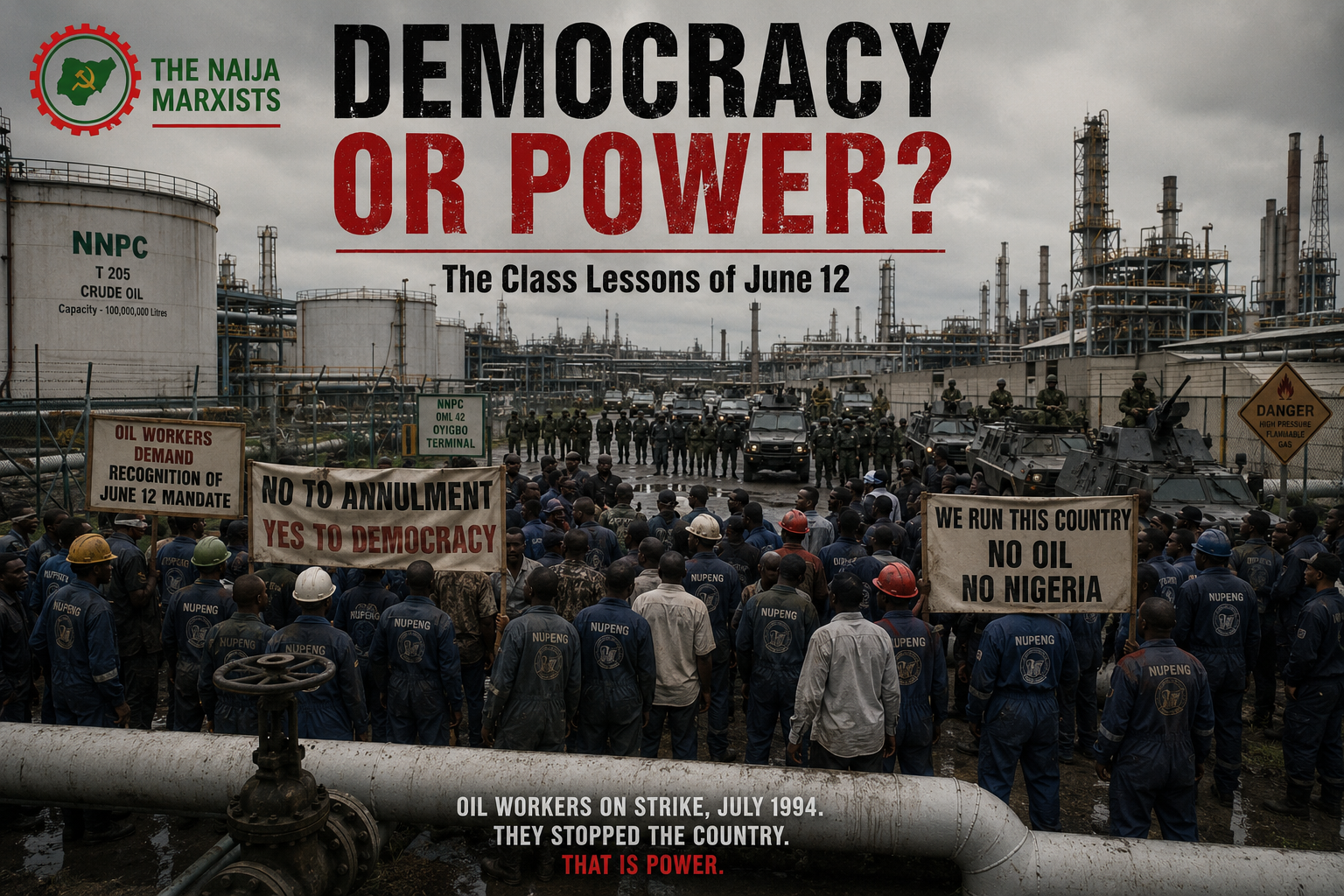
The sharpest blow against the annulment came from the oil workers. In July 1994 NUPENG under Frank Kokori, joined by PENGASSAN, went on strike demanding the recognition of June 12, and oil sector came to a standstill.
This was a political strike, workers using their position in production to intervene in the question of who governs Nigeria, and it proved that the working class, though a minority of the population, holds the power and strategic position, to halt the engine of this country. The regime arrested Kokori and Wariebe Agamene, terrorised their families and broke the strike by September, with the complicity of the NLC leadership.
Pascal Bafyau, NLC President from 1988 to 1994, headed a bureaucracy that feared the power of its own members more than it feared the military. The Congress called strikes in 1993 against fuel prices and against Shonekan, then suspended both when the government offered “dialogue.” At the peak of the crisis, Bafyau was meeting and negotiating with Gen. Sani Abacha privately while his labour headquarters, his transport project and his endowment fund all fed on government money.
A union boss whose projects depend on the state will defend the state against his own members. Lenin called this layer the agents of the bourgeoisie inside the workers’ movement, and that same layer, in Nigerian clothes, sold out the strongest working-class action of the decade.
NADECO Asked for a President When the Moment Demanded Power
The National Democratic Coalition, NADECO, formed in May 1994, gathered politicians, lawyers and activists to fight for the restoration of the mandate, and many of its members, Gani Fawehinmi above all, paid in detention and exile. Their courage must be acknowledged and their limits highlighted also.
NADECO’s entire demand was Abiola’s installation within the existing state, so every strike, every protest and every death was channelled towards a goal that left the class structure of Nigeria untouched. Since Abiola’s programme threatened none of the relations of production that manufacture poverty here, the class structure of Nigeria would invariably have remained the same. Abiola’s presidency would have been a civilian capitalist government over the same dependent economy. The movement therefore fought for a change of government while the situation posed the question of a change of class power, and the gap between those two things determined its defeat.
The workers inside that movement had the capacity to go further. The oil strike was, in embryo, an instrument of working-class government. What they lacked was a revolutionary organisation able to tell them that their power lay in the oil strike, to connect the strike to a revolutionary programme, and fight for a proper workers’ government. The socialist left was weak and fragmented, the union leadership was bought, and so the moment passed.
The radical wing of the movement followed the same road. The Campaign for Democracy, chaired by Beko Ransome-Kuti with Femi Falana and Fawehinmi at its head, contained the most courageous fighters of the period and absorbed the organised left, including the Socialist Congress of Nigeria and the Socialist Revolutionary Vanguard, into a struggle whose horizon was civilian rule within capitalism. Lacking a mass revolutionary party, and with sections of the left tailing the right wing of the coalition outright, these layers resigned themselves to fighting for a democracy that would leave exploitation intact, and the Nigeria of today is the harvest of that resignation. Tinubu, now president over the same exploited population, marched in that same pro-democracy camp, which measures both the limits of those struggles and the class collaboration at their core.
Abacha, meanwhile, painted June 12 as a Yoruba cause, splitting workers along ethnic lines and strangling the chance of a revolutionary Nigerian movement. The repression was savage: detentions, closed newspapers, killings in the street, and the hanging of Ken Saro-Wiwa in 1995. Abiola died in detention in 1998 while the generals arranged their own exit.
1999: New Clothes for the Same Class
The handover of 1999 changed the uniform of the ruling class without changing its rule.THis is what Antonio Gramsci called this passive revolution, where a ruling class in crisis rebuilds its authority through a managed transition that absorbs popular demands while draining the movement of its content and neutralising it from below.
The military returned to barracks, Obasanjo, a retired general, took office under the PDP, the networks enriched under military rule repositioned themselves inside the civilian parties, and SAP continued under the new names of privatisation, deregulation and subsidy removal. The form of rule changed; its class content did not.
The labour movement went through the same process. Adams Oshiomhole led seven general strikes after 1999 and ended his tenure with the NLC sitting on the National Privatisation Council, the engine room of the very policies his strikes had opposed. He then abandoned the Labour Party he helped build, governed Edo State for the bourgeoisie and chaired the APC. His road shows the structural limit of union militancy without a revolutionary party: the most combative leadership, left to itself, is eventually absorbed by the class it fought.
The Lessons
We are in 2026 and the conditions of 1993 have deepened. Unemployment stands above 30%, the naira has been devalued again and again, the subsidy is gone, and every Fourth Republic government has institutionalised the adjustment programme of the 1980s. The Democracy Day holiday converts the memory of mass struggle into a legitimising myth for the order that struggle opposed.
So what are the lessons from history?
June 12 belongs to the whole Nigerian working class, North, South, East and West, because the contradictions that produced it press on Hausa, Yoruba, Igbo and Ijaw workers alike, and every ethnic reading of it is a gift to the ruling class.
The labour bureaucracy will keep suspending and selling general strikes until workers take control of their own unions and refuse settlements that leave the class defeated.
Democratic rights are battlegrounds worth defending with everything we have, and they remain a means to the end of working-class political power; a movement that treats the bourgeois ballot as its destination has already conceded the journey.
Furthermore, the strike of 1994 proved that workers can stop this country, while proving just as clearly that stopping it achieves nothing lasting without a party and a programme to turn the stoppage into a new government.
Finish Their Work
The people killed on the streets of Lagos in 1993 and 1994 deserve better than a public holiday administered by the heirs of the system that killed them. They fought for a country where the wealth their labour produces stays with those who produce it, and where a child enters school and a parent enters hospital without the family being ruined.
Honour them by building what their movement lacked: a revolutionary organisation rooted in the working class, armed with a programme, prepared for the mass eruptions that Nigerian capitalism will certainly produce again.
When the next eruption comes, either the energy of the masses is channelled once more into rescuing a system built against them, or it is organised into the conquest of power by the class that keeps this country alive. The answer worth giving is working-class power, and the work has begun.
This is the job of the Naija Marxists. Join us.
Workers of Nigeria, unite. The chains you have to lose are real, and the Nigeria you can win is worth fighting for.
@TheNaijaMarxists