David Hundeyin and the Poverty of Conspiracy Theory
The battle for a revolution begins as a battle of ideas. People must believe that what passes for the impossible can be changed, that the institutions governing their lives are neither natural nor eternal. That conviction sets the masses in motion to push against their oppressors and demand a better system, one that serves the majority over the minority. Once the idea of revolution grips the masses, it transforms into a concrete, actionable material force. However, wrong ideas can cripple a revolutionary movement even when it appears militant, popular or fearless. Imperialism and the Indonesian ruling class crushed a revolutionary movement, so also the movement led by Salvador Allende was bloodily put down in Chile in 1973, and the exhaustion of the African liberation struggle warns that without a concrete analysis of class forces, the masses can be mobilised only to find themselves subordinated to another ruling class.
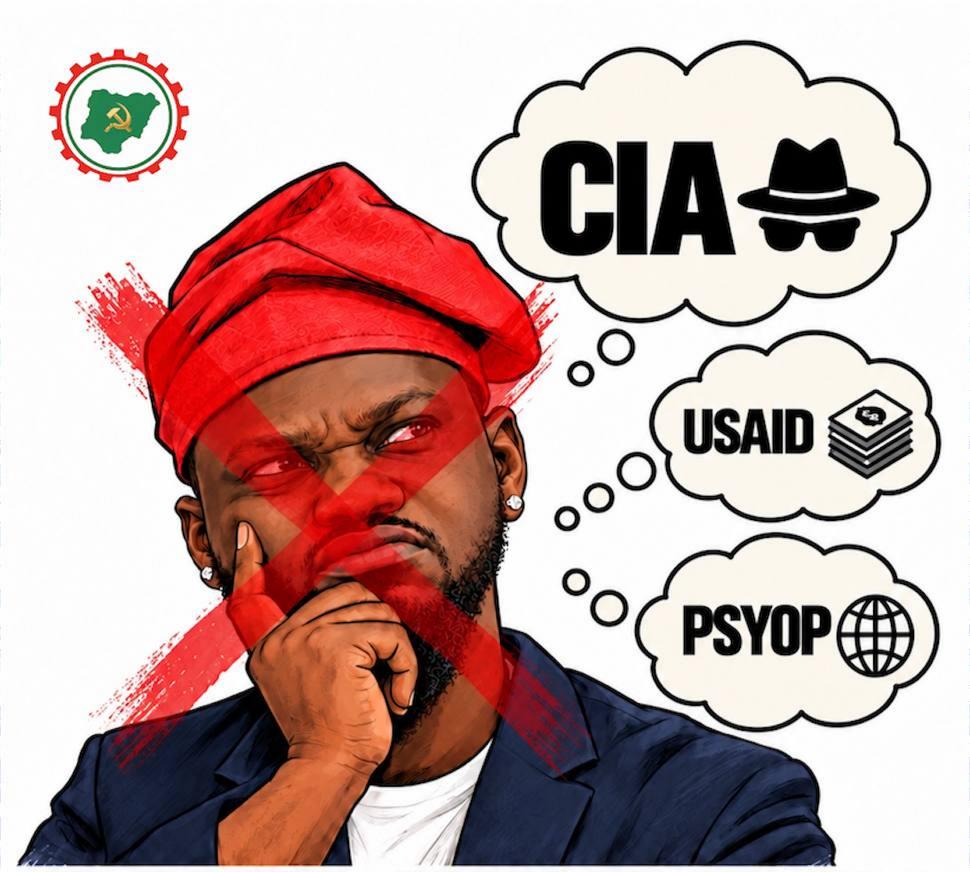
This is why Marxists insist that “Without revolutionary theory there can be no revolutionary movement.” Its meaning is more demanding than a slogan. Revolutionary theory explains which classes drive events, whose interests the state serves and what contradictions make change possible. It is not patriotic rage, geopolitical instinct or a catalogue of covert operations. It distinguishes an enemy from a symptom, a cause from an effect, and a possible ally from an opportunist. David Hundeyin’s public politics demonstrate the opposite method: a mixture of nationalist resentment, authoritarian nostalgia, anti-liberal culture-war rhetoric and conspiracy theories in which the CIA, USAID and “Western intelligence” explain almost every political and economic conflict in Africa. A doctor who mistakes the symptom for the disease prescribes a remedy that deepens the sickness and may eventually lead to death. In politics, the patient who pays is the working class and the masses.
Theory is not connection-making
The problem, then, is not simply that the quack doctor arrives at the wrong diagnosis, it is that his method of diagnosis is fundamentally defective: observing a symptom, identifying something associated with it, and declaring that the cause is discovered. In politics, this is the difference between revolutionary theory and conspiracy theory. The latter may uncover real connections, sometimes even important ones, but a connection is not, in itself, an explanation. To establish that two forces are connected is not yet to explain the nature of their relationship, the material interests that sustain it, or the contradictions that give rise to it. Revolutionary theory must do more than identify the actors in a political drama; it must explain the social relations that produce the drama itself.
A dialectical materialist (scientific) analysis of Nigeria, for instance, must begin with the structure of Nigerian society and the class relations upon which its political and economic institutions rest. What is the structure of the Nigerian state? Who controls oil rents, public contracts, finance, land and labour? How are foreign capital and domestic capital linked and through what mechanisms do they reproduce their dominance? What interests are advanced by a policy, and which classes bear its costs? These are not incidental questions but are the foundation upon which any serious analysis of imperialism must begin.
Conspiracy theory proceeds in precisely the opposite direction. It begins with a connection, perhaps an NGO grant, a foreign donor, an American institution or an intelligence contact, and elevates that connection into a complete explanation of political events. Once a connection to the United States is established, the investigation is effectively over. The CIA becomes the hidden hand behind every inconvenient event, USAID becomes the explanation for every political mobilisation, and the contradictions within African societies disappear beneath the convenient fiction of an all-powerful foreign manipulator. The existence of a relationship is treated as proof of control, and proof of control as an explanation of causation.
It would be disingenuous, of course, to deny the reality of malicious foreign intervention. The history of Africa supplies abundant evidence through coups, covert operations, structural adjustment, debt discipline and resource extraction. But this history does not operate as a blank cheque for every particular allegation. Imperialism operates through domestic elites, class interests, military bureaucracies, multinational capital and the state itself. When these relations disappear from the analysis, imperialism ceases to be a historically specific stage of capitalism and becomes a mystical force.
Hundeyin’s record
It is precisely this substitution of conspiracy for material analysis that runs through Hundeyin’s political commentary. He has portrayed the 2015 election as an American psychological operation, accused Omoyele Sowore of being “the biggest plant in West Africa” because Sahara Reporters received foreign foundation funding, and described Aisha Yesufu and Yemi Adamolekun as participants in “another CIA colour revolution in Abuja”. In the latter case, he went further, declaring: “It’s better for those few to die than for the future of millions of people to be sacrificed.” Yet foreign funding does not automatically establish intelligence control, nor does political opposition constitute evidence of a foreign conspiracy.
His interpretation of Goodluck Jonathan and Occupy Nigeria exposes the contradiction most clearly. Hundeyin has alleged that the CIA funded the January 2012 protests and engineered Jonathan’s defeat in 2015. He has even wished that Jonathan had jailed or silenced his supposedly CIA-backed critics. But what was this alleged anti-imperialist president actually doing? On 1 January 2012, Jonathan removed the petrol subsidy, sending prices from ₦65 to approximately ₦141 per litre. His government pursued the subsidy removal and market liberalisation long promoted by the IMF and World Bank, institutions through which international capital exercises enormous influence over dependent economies. In 2013, it also privatised much of Nigeria’s electricity sector. The supposed victim of imperialism was implementing an economic programme championed by its financial institutions.
The Nigerian masses resisted. Workers, students and ordinary Nigerians filled the streets, while the NLC and TUC called a general strike that forced petrol prices down to ₦97 before the labour leadership suspended the action. Hundeyin’s conspiracy turns this struggle upside down: a government advancing policies favoured by international finance becomes the nationalist victim, while workers resisting those policies become imperialist agents. Nor did Jonathan’s electoral defeat end Nigeria’s dependence on international capital. Buhari inherited and largely preserved the same economic order.
More fundamentally, Hundeyin’s contemptuous depiction of Nigerians as people without a protest culture is an insult to their revolutionary history. From the 1945 general strike against British colonial rule and the 1949 Enugu miners’ struggle to resistance against military dictatorships, the anti-SAP uprisings, Occupy Nigeria and #EndSARS, the Nigerian masses have repeatedly confronted their oppressors. Their problem has never been an absence of willingness to struggle, but the absence of revolutionary leadership capable of transforming these struggles into a sustained challenge to capitalist class rule. Hundeyin cannot explain this history because his framework reduces the masses to instruments of hidden foreign actors. The conspiracy and the contempt belong together: when workers struggle, they are manipulated; when they do not, they are condemned as incapable of resistance. What disappears in both cases is the independent revolutionary agency of the Nigerian working class.
From Conspiracy to the Strong State
The consequences of this method become particularly serious when applied to Boko Haram. Hundeyin has described USAID as an intelligence-community “slush fund”, while The Spearhead, the organisation he founded, has promoted allegations that USAID funds Boko Haram. Yet his own 2021 investigation, Cornflakes for Jihad, traced the insurgency’s ideological and financial networks through Saudi-funded Salafism, Algerian jihadist connections and the complicity of Nigerian officials. By 2025, Washington had become the centre of his explanation. What happened to the Nigerian officials, ruling elites and material conditions identified in his earlier investigation? The problem is not investigating possible American involvement, but allowing the allegation of foreign interference to displace an analysis of the domestic forces sustaining the insurgency.
This is more than a methodological error. It has political consequences, particularly when the same conception of imperialism is used to rehabilitate domestic capitalists and authoritarian rulers. Imperialism is capitalism in its monopoly stage, characterised by the dominance of finance capital, the export of capital and the division of the world among great powers. In Nigeria, it operates through a domestic ruling class whose accumulation is bound to international capital. Consider Dangote, whose refinery has challenged European refiners while selling petrol to Nigerians at prices shaped by international oil markets and the dollar, despite the oil being extracted and refined on Nigerian soil. The Nigerian worker bears the burden of global prices while the Nigerian billionaire competes with European capitalists for profits. Their quarrel is over markets and profits, not the exploitation of Nigerian workers. A capitalist does not become anti-imperialist merely because his interests conflict with foreign capital. We shall examine these contradictions in a subsequent article.
The same class blindness underlies Hundeyin’s rehabilitation of Sani Abacha, whom he has called Nigeria’s “most misunderstood president” and portrayed as an ambitious nationalist. Yet Abacha’s regime executed Ken Saro-Wiwa and eight other Ogoni activists in 1995 amid their struggle against Shell’s exploitation of the Niger Delta. It crushed organised labour, dissolved the leadership of the NLC, NUPENG and PENGASSAN, and imprisoned M.K.O. Abiola, who died in detention. Western governments condemned his dictatorship but stopped short of an oil embargo that would threaten their commercial interests. Abacha’s diplomatic isolation was no struggle against imperialism. His regime repressed Nigerian workers while protecting an oil economy dominated by foreign capital. What, then, makes him a nationalist hero?
The same confusion appears in Hundeyin’s celebration of the Sahel juntas. In April 2026, he described Mali’s military takeover and rupture with Western powers as a revolution. But replacing a government, or exchanging Western influence for that of another foreign power, does not constitute a social revolution. A revolution must transform the class relations and structures of power within society.
One Test for Every Power
Hundeyin’s changing attitude towards Donald Trump further reveals the limits of his analysis. Following Trump’s 2024 victory, he welcomed the prospect of a “chainsaw” being taken to Washington’s establishment. When Trump moved against USAID, he even wondered whether the president was “secretly a Pan-Africanist”. Yet Trump’s subsequent threats of military action against Nigeria exposed the weakness of this reasoning. American imperialism does not begin or end with the preferences of its president. Trump could dismantle USAID while defending American monopolies, finance capital and military supremacy. The instruments changed; the class interests remained.
Libya presents a deeper contradiction. NATO’s 2011 intervention was destructive, but Gaddafi’s government had already spent years accommodating Western capital. After 2003, he normalised relations with Washington and Europe, welcomed foreign investment and pursued market reforms. Shell signed an agreement in 2004, BP secured a major exploration deal in 2007, and the IMF praised Libya’s economic liberalisation shortly before the 2011 uprising. Yet unemployment persisted, and independent political opposition remained repressed. The celebrated opponent of imperialism was welcoming Western oil companies and implementing reforms applauded by international finance. These contradictions contributed to the conditions preceding the uprising, although they neither fully explain it nor justify NATO’s intervention. The point is that opposition to NATO cannot erase the class character of the government it attacked.
Tanzania takes the argument further. Following the October 2025 elections, security forces violently suppressed protesters, with a government commission subsequently recording at least 518 deaths. Hundeyin portrayed the unrest as another Western-backed colour revolution. Yet Tanzania had received substantial IMF financing, including another $448 million approved in June 2025, while Western corporations such as Shell, Equinor and ExxonMobil remained involved in its natural gas industry. Here was a government accommodating international capital while suppressing its own population, yet resistance to its rule was presented as an imperialist conspiracy. The contradiction is no longer merely about which government Hundeyin supports. It concerns whether African workers and ordinary citizens are recognised as capable of opposing their rulers independently of foreign intelligence agencies.
Why Is Hundeyin Anti-Truth?
Hundeyin’s political oscillations demand a class analysis, not merely accusations of personal hypocrisy. How does a former free-market columnist become a champion of sovereignty? How does a commentator hail Trump as a possible Pan-Africanist, only to denounce American aggression against Nigeria months later? These contradictions reflect the politics of the petty-bourgeois nationalist, caught between foreign capital and the working masses, whose independent political power he distrusts. Unable to see beyond capitalism, he seeks salvation in a “strong” national ruler, a “national” capitalist or a friendly foreign power. His admiration for Abacha, his defence of Dangote and his contempt for popular movements are therefore not isolated episodes, but expressions of the same class outlook.
Hundeyin has criticised Marxists for elevating theory over action, invoking the Iranian Revolution against supposedly doctrinaire Marxist objections. Yet Iran demonstrates the danger of precisely this approach. The Tudeh Party supported Khomeini in the name of anti-imperialism, only to be crushed by the Islamic Republic alongside independent workers’ and left-wing organisations. The overthrow of a pro-American monarchy did not abolish exploitation or place power in the hands of the working class. The party’s failure to maintain its political independence helped deliver its members to the gallows.
Marxism does not separate theory from action. Revolutionary praxis requires theory to guide struggle and struggle to test theory. Without an independent class programme, the forces that overthrow one oppressor can fall under the domination of another. We oppose imperialist intervention in the Alliance of Sahel States (AES) without giving political support to its military rulers. We recognise the role of foreign-funded NGOs in advancing imperialist interests without branding every activist an intelligence operative. The test is not which foreign power a government opposes, but which class it serves.
The Cure
Hundeyin’s prescription directs popular anger towards hidden conspirators while leaving the material foundations of exploitation untouched. But the Nigerian worker’s enemy is not hidden. Tinubu, Atiku, Obi, the generals, Dangote and the governors represent factions of a ruling class whose accumulation is bound to foreign capital. The Western powers Hundeyin denounces depend upon this class, just as Russian and Chinese capital would pursue its interests through similar relationships.
Marx’s declaration that “the emancipation of the working classes must be conquered by the working classes themselves” remains the starting point. Nigeria’s liberation requires workers organised independently of every faction of the bourgeoisie, fighting for democratic control of the oil industry, refineries, banks and the state. Against this movement, the ruling class will defend its property and privileges with the coercive power of the state, as it has repeatedly done throughout Nigerian history. The immediate struggles over fuel prices, wages and living conditions demonstrate the urgency of this task. Yet Hundeyin offers his followers a hunt for foreign agents where revolutionary organisation is needed. Their anger at imperialism and the Tinubu government is real, but anger without revolutionary theory can be turned against the very people it ought to liberate.
To the young Nigerians who follow him, we say: keep the anger, but throw away the quack’s prescription. Study the forces that rule Nigeria, organise in your workplaces and communities, and build the revolutionary party capable of turning mass resistance into a struggle for workers’ power. Theory is not a witch-hunt for hidden enemies; it is the instrument through which the working class understands the causes of its oppression and develops the means to end it.
Workers of the world, unite!